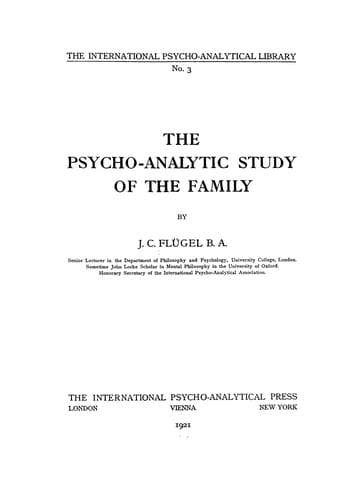
The psycho-analytic study of the familyFlugel, J. C. (John Carl)
Science
The psycho-analytic study of the family
Flugel, J. C. (John Carl)
Families; Marriage; Parent and child; Psychoanalysis
In order that the benefits and compensations attendant upon an
identification of this sort may be achieved, it is necessary that there
should take place a gradual change of attitude towards the child on the
part of the parent--a change which is very necessary also upon other
grounds. In the fourth and fifth chapters of this book we studied the
manner in which the successful development of the child requires an
ever increasing degree of emancipation from the ties of affection and
dependence which bind him to the parent. The proper carrying out of this
emancipation requires a corresponding loosening of the ties that bind
the parent to the child, involving a readjustment in the direction of
the parent's interests and affections. If the parent continues to lavish
on the child, as he grows up, the same amount of attention and affection
that he required in infancy, the normal development of the child's love
impulses is liable to be very seriously impeded; and should the child, in
spite of this difficulty, attain the stage of directing his love outside
the family, the parent is bound to suffer disappointment at what appears
to him (or at least to his unconscious mind) to be the thanklessness and
faithlessness of his child, and to feel jealousy and hatred towards the
person who has supplanted him in the child's affection. Similarly, should
the parent too long or too extensively afford protection to the child,
exercise authority over him or take over responsibility from him, the
child will inevitably find it difficult to acquire the necessary degree of
emancipation from the parent's care and jurisdiction; and should he after
all succeed in acquiring such emancipation, the parent will certainly
suffer as the result of being deprived all too suddenly and unwillingly
of the directive power over the child which he had hitherto enjoyed, and
of the outlet for his interests and emotional tendencies, which the care
of a child had hitherto afforded. The extreme demands on the energies and
affections of the parents (particularly on those of the mother) caused
by the utter helplessness of the human infant grow progressively less as
the child develops. The natural course of events demands therefore on the
part of the parents a gradual modification, redistribution and redirection
of the emotions and interests that centred round the child in its early
life; an undue prolongation of the tendencies natural to the early days
of parenthood must necessarily in the long run be detrimental to the true
interest both of child and parent.
[Sidenote: Difficulty and importance of this readjustment]
Public-domain text, read in full here on John Shaqi.
Reviews
Reviews
No reviews yet
Be the first to share your thoughts on this work.
Elsewhere in the archive
Join the Discussion
Join the discussion
Sign in to leave a comment or review.
Sign InorCreate an account