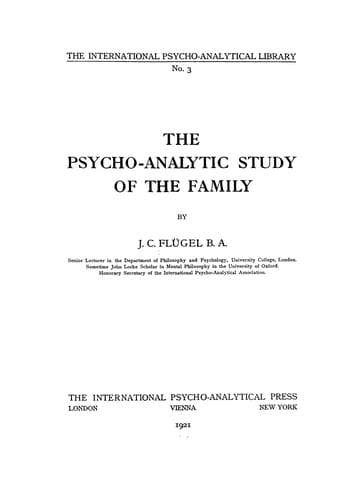
The psycho-analytic study of the familyFlugel, J. C. (John Carl)
Science
The psycho-analytic study of the family
Flugel, J. C. (John Carl)
Families; Marriage; Parent and child; Psychoanalysis
Obvious as these considerations may well seem to be, the logical carrying
out of the conclusions to which they point is often far from easy. In
practice it is often as hard for parents to wean themselves from their
primitive attitude towards their children, as it is for the children
themselves to acquire the necessary mental and moral independence of
their parents. The intense and profound emotions stirred up in the parent
by his relation to the child are not readily displaced into any other
channel, and fixation at a level only suited to the early stages of the
filio-parental relation may easily result. The consequent struggle of
the parent to keep possession of the child gives rise to some of the
most serious and tragic problems of family life. It is one of the chief
causes of the friction that so often exists between the older and younger
generations of the same family; it tends, as we have seen, to hamper the
mental and moral development of children and to foster in them psychical
conflicts which may produce permanently evil effects upon their character:
in the parents themselves it often favours selfishness and real disregard
for the children's welfare, under the guise of altruistic tenderness and
care; and finally it causes much unhappiness to the parents when, as
inevitably happens to some extent, they observe that, in spite of all
their efforts, their children are in one manner or another drifting from
them, as by coming under the influence of friends who are outside the
circle of the parents' acquaintance, by the adoption of habits, interests
or careers that are opposed to family tradition, or by marriage to persons
who to the parents' eyes appear to be unsuitable[214].
[Sidenote: The attitude of parents to the marriage of their children]
Public-domain text, read in full here on John Shaqi.
Reviews
Reviews
No reviews yet
Be the first to share your thoughts on this work.
Elsewhere in the archive
Join the Discussion
Join the discussion
Sign in to leave a comment or review.
Sign InorCreate an account