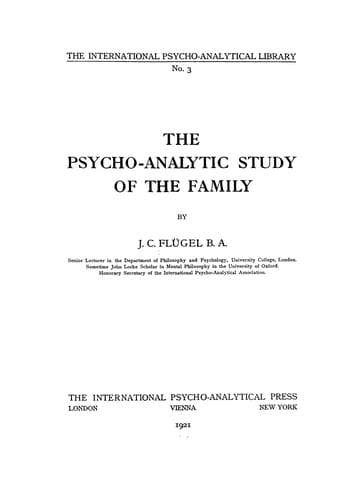
The psycho-analytic study of the familyFlugel, J. C. (John Carl)
Science
The psycho-analytic study of the family
Flugel, J. C. (John Carl)
Families; Marriage; Parent and child; Psychoanalysis
The question of marriage is, under existing conditions one of special
importance in this connection, since nothing else (with the exception
perhaps of permanent separation in space) tends to cut off individuals to
an equal extent from the direct influence and contact of their parents.
Parents who ardently desire to retain a strong influence over their
children are therefore as a rule opposed to the marriage of the latter,
and usually display marked antagonism to their sons or daughters-in-law:
an antagonism which is the source of very frequent domestic unhappiness.
Since the marriage of their children is however in many cases difficult
or impossible to avert, such parents will often seek to minimise the
disturbing effect of marriage by arranging that their children shall live
near them after marriage or that they shall marry a partner whom they
regard as suitable. In estimating suitability for this purpose, they are
usually guided by the extent to which the partner in question is likely
to constitute a serious obstacle to the operation of their own (the
parents') influence. Hence it often comes about that the persons selected
are sexually unattractive, of weak character or deficient in intellectual
power[215].
[Sidenote: Means of avoiding insufficient parental re-adjustment]
The avoidance of the evils consequent upon the insufficient readjustment
of the parents attitude towards their children is one of the most pressing
tasks of an enlightened hygiene of family life. In the accomplishment of
this task it would seem that there are two factors which are of great
importance: in the first place, the happiness of the relationship between
the two parents themselves (for, as we have seen, it is especially
in cases when marriage is unsuccessful that there is likely to be an
excessive outflow of emotion in the direction of the children); in the
second place, the maintenance of outside interests, hobbies or occupations
throughout the period of parenthood and the gradual reinforcement of
such interests as the growth of the children renders the demand upon the
parent's energy less extensive and continuous. Where the circumstances in
these two respects are satisfactory, they usually permit of the necessary
readjustment of parental energies with the minimum of friction and
suffering.
FOOTNOTES:
[Footnote 200: Mr. Shand's term, adopted by McDougall, is perhaps (in
England at any rate) the most generally used and understood in this
connection. The term Constellation is, however, used in the same sense by
psycho-analytic writers. A Sentiment (or Constellation) differs from a
complex only in that it manifests itself openly in consciousness, whereas
the complex is unconscious.]
[Footnote 201: Often, too, unmarried mothers; though in this case, owing
to the fact that under existing social conditions children born out of
wedlock cause more than the usual amount of anxiety and trouble, love is
very liable to be complicated or even replaced by hate.]
Public-domain text, read in full here on John Shaqi.
Reviews
Reviews
No reviews yet
Be the first to share your thoughts on this work.
Elsewhere in the archive
Join the Discussion
Join the discussion
Sign in to leave a comment or review.
Sign InorCreate an account