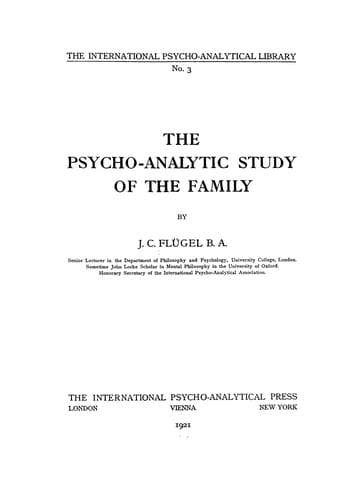
The psycho-analytic study of the familyFlugel, J. C. (John Carl)
Science
The psycho-analytic study of the family
Flugel, J. C. (John Carl)
Families; Marriage; Parent and child; Psychoanalysis
[Footnote 210: The identification of the child with its grandparent is of
course not without effect upon the mind of the child himself, where it is
reinforced by a variety of other motives, such as:--the wish to become
the parent of his own parent (_i. e._ the corresponding notion to that
in the mind of the child's parent which we have just been considering),
the wish to dispense with his parent (_cp._ p. 109), the projection on
to the grandparent of the grandiose ideas formerly entertained with
regard to the parent (_cp._ p. 55), and finally the results of the happy
relationship that often exists between child and grandparent (owing to the
fact that the grandparents are as a rule less responsible for the child's
upbringing and education and less stern and vigorous in the assertion of
their authority). As a consequence there may arise in the child a strong
tendency to imitate the grandparents--a tendency that may constitute an
important factor in moulding the child's beliefs, attitudes, desires, and
occupations. _Cp._ Ernest Jones, "Papers on Psycho-Analysis," 652, ff.]
[Footnote 211: "Die Couvade und die Psychogenese der Vergeltungsfurcht."
_Imago_, 1914, III.]
[Footnote 212: As an example of an attitude obviously akin to one of the
main tendencies underlying the Couvade--a desire to inflict pain upon the
mother--we may mention the strong objection that was originally taken to
the use of anaesthetics in midwifery, on the ground that the suffering of
pain in childbirth was a just punishment for sin and that it was therefore
ethically undesirable to seek to do away with or abate this pain.]
[Footnote 213: For these reasons it would seem very undesirable to
tamper to any appreciable extent with the motives that may impel a man
to work for the advantage of his immediate posterity; as would be done
for instance, by any prohibition to transmit property to heirs, or by any
measure that too greatly diminished the value of such property, such as an
excessive death duty.
What seems to be to some extent the American ideal of each generation
"making good" in their own persons, is of course based mainly on perfectly
sound ethical and psychological considerations. There is nothing in
these considerations however which is incompatible with the hereditary
transmission of wealth or rank. On the contrary, it would seem to be an
ennobling and inspiring ideal for each generation to start life at a
somewhat higher all-round level--material and moral--than the one before
it, each one adding a little to the well-being of the family in body and
mind and handing on the improvement to its successor.
Public-domain text, read in full here on John Shaqi.
Reviews
Reviews
No reviews yet
Be the first to share your thoughts on this work.
Elsewhere in the archive
Join the Discussion
Join the discussion
Sign in to leave a comment or review.
Sign InorCreate an account