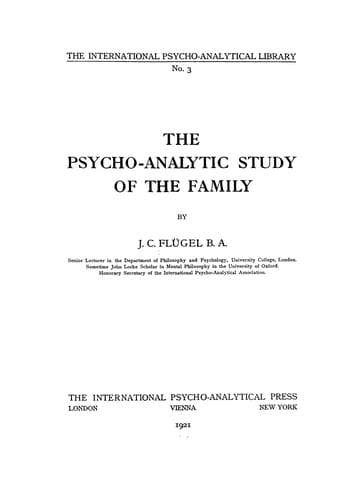
The psycho-analytic study of the familyFlugel, J. C. (John Carl)
Science
The psycho-analytic study of the family
Flugel, J. C. (John Carl)
Families; Marriage; Parent and child; Psychoanalysis
In spite of the great advantages that may thus follow from the
identification of the parent with his children, it behoves us not to
overlook one possible danger that may ensue from it, if carried to excess.
An individual's actions affect posterity, not only in the persons of his
own offspring, but also by their influence on the history of humanity
at large; and it would be highly undesirable if, while contemplating
the benefit of his own family, an individual ceased to bear in mind his
duties to the wider circles of his social environment. The deeds of great
men obviously determine to a considerable extent the future of the race.
It is however the privilege of all of us to contribute to this history
to some degree; hence an enlightened morality must needs emphasise the
responsibility that is incurred in this respect even by the humblest,
since, by his actions during life, he has to some extent made himself
immortal, and influenced the world through all time for good or ill.]
[Footnote 214: It may be well to bear in mind in this connection Mr.
Bernard Shaw's striking words from his brilliant essay on Parents and
Children (the whole of which deserves most careful reading). On the
subject of marriage from the point of view of the parents, he writes
with his usual penetration and with a generous understanding of the real
difficulties of the situation:--"Take a very common instance of this
agonizing incompatibility" (between the point of view of parents and
that of the children). "A widow brings up her son to manhood. He meets a
strange woman, goes off with and marries her, leaving his mother desolate.
It does not occur to him that this is at all hard on her; he does it as
a matter of course, and actually expects his mother to receive on terms
of special affection, the woman for whom she has been abandoned. If he
shewed any sense of what he was doing, any remorse; if he mingled his
tears with hers, and asked her not to think too hardly of him because he
had obeyed the inevitable destiny of a man to leave his father and mother
and cleave to his wife, she could give him her blessing and accept her
bereavement with dignity and without reproach. But the man never dreams
of such considerations. To him his mother's feeling in the matter, when
she betrays it, is unreasonable, ridiculous and even odious, as shewing a
prejudice against his adorable bride.
Public-domain text, read in full here on John Shaqi.
Reviews
Reviews
No reviews yet
Be the first to share your thoughts on this work.
Elsewhere in the archive
Join the Discussion
Join the discussion
Sign in to leave a comment or review.
Sign InorCreate an account