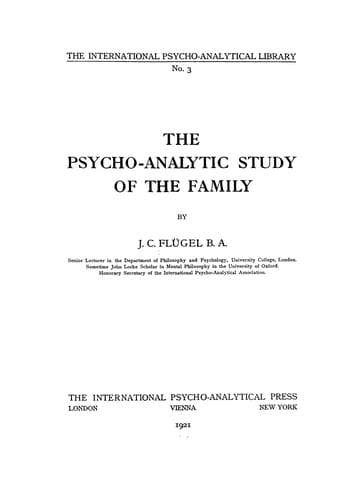
The psycho-analytic study of the familyFlugel, J. C. (John Carl)
Science
The psycho-analytic study of the family
Flugel, J. C. (John Carl)
Families; Marriage; Parent and child; Psychoanalysis
Much the same is also true, no doubt, as regards those aspects of
intra-family hostilities which are not based on jealousy. In the monogamic
families of primitive man these latter aspects of hostility had no doubt
free scope within certain limits. In the looser family conditions of the
Totemic age it seems probable that passions based on mutual interference
of different members of the family with each other's interests and desires
would be a good deal less developed. In the patriarchal family of the
later epoch conditions would seem however to become favourable once again
to the development of hostility of this kind, particularly to that between
father and son. The close and permanent organisation of the family under
the patriarchal system brings it about that the interests of father and
son continue to be to some extent antagonistic long after the son has
reached maturity, whereas in the state more nearly resembling that of
nature the son would usually be free from paternal tutelage as soon as he
had attained to full growth.
[Sidenote: The hate-producing causes are still potent in modern
civilisation]
The family life of most modern civilised nations is less closely organised
than that of the patriarchal family at its full development; children as
a rule becoming relatively or completely free from parental jurisdiction,
if not before, at least as soon as, they have married and founded a home
of their own. Nevertheless the lessening of antagonism that is brought
about by this relaxation of the family organisation is often to some
extent counterbalanced by the increasing social and economic dependence
of children on their parents that is apt to arise in advanced and complex
societies, specially among the higher and wealthier classes (_cp._ above
p. 58). The irksomeness of parental restrictions is apt to be increased
too, as civilisation advances, by the fact that the rules of conduct
and of morals inculcated by the parents tend to become in many respects
increasingly remote from the behaviour to which the young child's
primitive tendencies naturally impel him; so that a more violent friction
is likely to arise between the authority of the parents and the will of
the children in their early years[221].
For these reasons the antagonism between parents and children remains, as
we know, strong even in present day civilisation, though there are grounds
for thinking that it may perhaps have been stronger in those earlier
stages of society in which a more complex patriarchal system flourished.
[Sidenote: Negative aspects of the hate attitude]
Public-domain text, read in full here on John Shaqi.
Reviews
Reviews
No reviews yet
Be the first to share your thoughts on this work.
Elsewhere in the archive
Join the Discussion
Join the discussion
Sign in to leave a comment or review.
Sign InorCreate an account