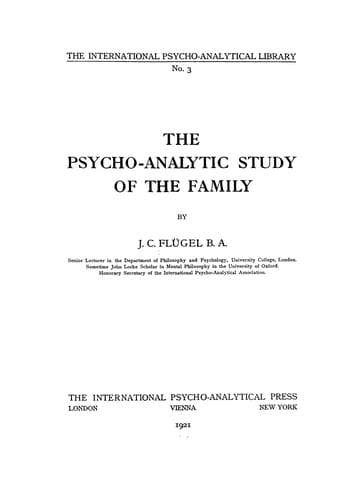
The psycho-analytic study of the familyFlugel, J. C. (John Carl)
Science
The psycho-analytic study of the family
Flugel, J. C. (John Carl)
Families; Marriage; Parent and child; Psychoanalysis
Another interesting question relating to the direction of object love
towards the parents is connected with the fact that, in the case of
female children, the influences making towards heterosexual choice of
object would seem, under normal conditions of upbringing, to be liable
to conflict with the tendency for the affections of the child to go out
in the first place towards those to whom the child is chiefly indebted
for the satisfaction of its more immediate bodily needs. Under these
circumstances it might perhaps be expected that it would be usual for
girls to pass through a stage of mother love before transferring the
greater part of their affection to their father. There is much reason
to think that the number of girls retaining an unusual or pathological
degree of mother love in later years is greater than the number of boys
retaining a corresponding degree of father love; if this be the case, it
may perhaps be held to show that the mother is indeed the first object of
affection in both boys and girls and that some of the latter retain marked
traces of this stage of their development throughout subsequent life.
Additional evidence pointing in the same direction seems to be forthcoming
from a number of pathological cases among adult women, the study of which
has revealed the existence of a persistent and intense attachment to the
mother; this attachment being of an infantile character and situated
in a deeper and more inaccessible layer of the Unconscious than the
father love, which appeared to have been, in the process of growth, as it
were, superimposed upon the earlier affection. If father love in girls
should prove to be normally built upon the remains of an earlier period
of exclusive mother love which is common to both girls and boys, it is
evident that in this respect the development of heterosexual object love
in girls is a rather more complex process than it is in boys. This greater
complexity of the process of development may, as Freud himself has pointed
out in a somewhat different but not altogether unrelated connection[10],
become the cause of a number of those failures of adjustment to the
conditions of adult life--sexual and general--that are found to underlie
the neuroses. The greater incidence of certain neurotic disturbances among
women as compared with men may perhaps ultimately be due in part[11] to
the greater complexity of the original process by which the object love of
the child comes to be directed to the parent of the opposite sex.
[Sidenote: Jealousy]
Public-domain text, read in full here on John Shaqi.
Reviews
Reviews
No reviews yet
Be the first to share your thoughts on this work.
Join the Discussion
Join the discussion
Sign in to leave a comment or review.
Sign InorCreate an account