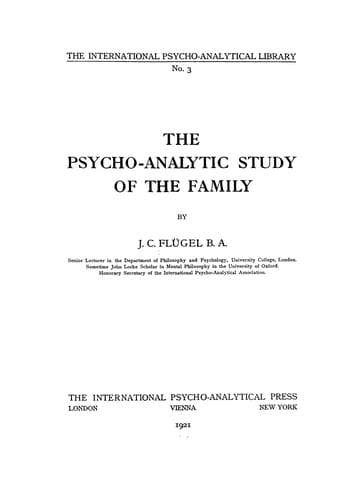
The psycho-analytic study of the familyFlugel, J. C. (John Carl)
Science
The psycho-analytic study of the family
Flugel, J. C. (John Carl)
Families; Marriage; Parent and child; Psychoanalysis
(8) The sentiment of parent love having been called into existence by
the aid of the factors we have already enumerated--directly in the case
of 1 and 2, more indirectly in the case of 4, 5 and 6 and still more
indirectly perhaps in the case of 3 and 7--all conditions are particularly
favourable for its continuance and growth. In the first place, it is
almost certainly one of the earliest important sentiments to be formed,
the only other one which can compare with it in this respect being the
self-regarding sentiment. It thus enjoys as compared with most others
sentiments all the advantage afforded by priority. What the exact nature
of any such advantage may be, it would be hazardous to suggest in detail:
we know however that it is a general characteristic of the function and
development of mind that dispositions which are formed early in the life
of the individual enjoy a greater stability and permanence than those
subsequently acquired. Even where, as so often happens, the function of
the earlier dispositions is modified or obscured by the results of later
experience, the phenomena of "regression" to earlier levels, as manifested
in pathology, show clearly enough that the earlier dispositions remain
intact throughout life and in many cases seem to be (in themselves and
apart from the influence of extraneous factors) paths that offer less
resistance to the passage of emotional energy than do those formed at a
later period. It may well be then that its priority of formation gives to
the sentiment of parent-love a more stable and deep-rooted foundation than
that enjoyed by any sentiment subsequently formed.
Further, psycho-analytic study appears to indicate very strongly that it
is in the nature of the mind for _all_ the earliest channels of conative
energy not only to remain capable of functioning in later life, but
actually to continue to function, though often in such a degree or in such
a way as to have but little if any _direct_ influence on consciousness
or action. Thus it would appear that when a sublimation is formed and
emotional energy is directed into a fresh channel, not all the energy
passing through the original channel is deflected; some, on the contrary,
continues to pass along the original channel. At each fresh sublimation
this process is repeated, so that, to use a simile of Freud's, we may
compare the development of the Libido to the history of a wandering tribe,
which at each fresh migration leaves some of its members behind in the
home it is just leaving (the larger the proportion of the population that
is left behind--_i. e._ the greater the fixations--the greater being of
course the tendency to regress along the former line of advance when an
obstacle is encountered). In such a system of function and development, it
is clear that the oldest channels are necessarily, in a sense, the most
stable and permanent, the least easy to modify or to destroy.
Public-domain text, read in full here on John Shaqi.
Reviews
Reviews
No reviews yet
Be the first to share your thoughts on this work.
Elsewhere in the archive
Join the Discussion
Join the discussion
Sign in to leave a comment or review.
Sign InorCreate an account