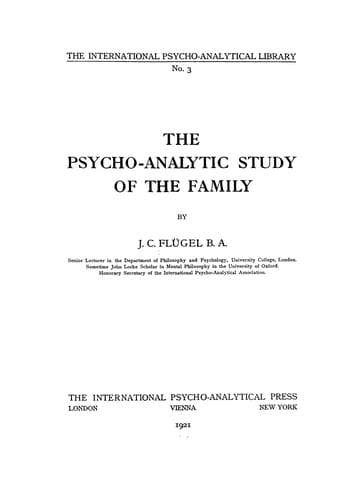
The psycho-analytic study of the familyFlugel, J. C. (John Carl)
Science
The psycho-analytic study of the family
Flugel, J. C. (John Carl)
Families; Marriage; Parent and child; Psychoanalysis
In this respect then the channels comprising the sentiment of parent-love
are comparable to all other early channels of the Libido. Just as the
autoerotic trends connected with the oral, anal and urethral regions
of the body and the primitive tendencies to sadism, masochism and
exhibitionism have been shown to underlie many of the activities of adult
life, so (on a higher and more complex level of development) parent-love
has been revealed as the foundation upon which rests the greater part of
the affection of childhood, adolescence and maturity. From this point of
view it would appear that parent-love, in its persistence and influence on
later life, exhibits characteristics which are, in greater or less degree,
common to all the earliest manifestations of the Libido.
[Sidenote: Furthermore, numerous influences favour its persistence]
In one important respect however the history of parent love differs from
the history of many other of these early manifestations. Parent-love not
only comes into being at a very early age, but, as regards many of its
attributes, it normally persists with but little alteration throughout
the whole of the impressionable period from infancy to adolescence. The
sensual elements of this love are, it is true, for the most part repressed
soon after they appear, but the elements of tenderness and veneration
usually remain and build up a sentiment which operates vigorously and
continuously for many years, whereas the other sentiments formed during
this period (with the exception again of the self-regarding sentiment)
are apt to be of a far more temporary and evanescent character. It is
true, as we have seen, that as development proceeds the affection felt
towards the parents is to some extent displaced on to other persons, but
nevertheless, in the normal course of events, a large portion of this
affection remains throughout early life fixated on its original object.
Moreover as regards this fixation of affection on the parents (provided
only no sensual element be too apparent), the individual meets as a rule
with every encouragement and sign of approval from those about him, not
with the disapprobation or ridicule which he often encounters when his
affections are directed elsewhere. The sentiment of parent love has
therefore the support of moral sanction in a way enjoyed by few, if any,
other sentiments of love that may be formed in early life.
We see therefore that both as regards priority of formation and as
regards duration, vigour and continuity of function throughout the all
important period of development, parent love normally occupies an almost
unique place among the sentiments--a place which renders to some extent
intelligible the importance of the role it plays in human life.
[Sidenote: The tendency to incest thus brought about is strengthened by
practice and tradition]
Public-domain text, read in full here on John Shaqi.
Reviews
Reviews
No reviews yet
Be the first to share your thoughts on this work.
Elsewhere in the archive
Join the Discussion
Join the discussion
Sign in to leave a comment or review.
Sign InorCreate an account