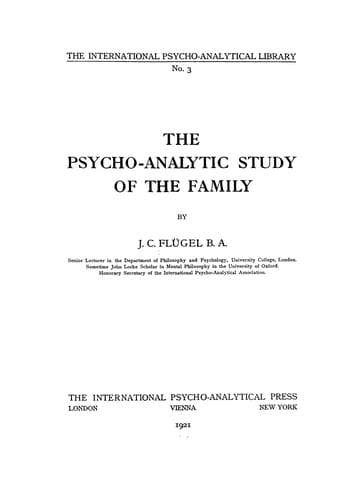
The psycho-analytic study of the familyFlugel, J. C. (John Carl)
Science
The psycho-analytic study of the family
Flugel, J. C. (John Carl)
Families; Marriage; Parent and child; Psychoanalysis
If these influences have made incest a common practice at one period of
man's history, in what ways has this practice contributed to the tendency
to incest found at a later date and at the present day? In view of the
widespread (we are probably justified in saying universal) occurrence of
this tendency, of the relative uniformity of its ultimate nature in spite
of manifold differences of culture, training, and environment, of the
great strength which it possesses even after ages of repression, there is
not unnaturally a temptation to regard it as an innate factor in man's
mental constitution, _i. e._, to assert that there is in man an hereditary
tendency to direct his love and sexual inclination to those who are of his
own blood or at any rate to those with whom he has been brought up and has
been familiar since his infancy[245]. Possibly in the long ages in which
man or his pre-human ancestors lived in relatively isolated families, this
tendency was of advantage in the struggle for existence, in so much as it
may have contributed both to more rapid multiplication and to the greater
consolidation, and therefore greater safety and stability, of the family,
as the most important social unit. The tendency to incest may thus be due
ultimately to the action of natural selection; the long period during
which incest was regularly practised may have established and ingrained
it as a normal feature of the race and its persistence to-day may be due
to the continuance of the hereditary disposition thus formed and thus
consolidated.
Apart from the direct influence of this hereditary factor however, a long
period during which incest was habitual may have affected the tendency to
incest at a later time through custom, law and tradition. These change
but slowly in a primitive society, and, through their inertia, would tend
to reinforce or maintain the hereditary factor, even when, owing to the
action of other causes, incest may have been abandoned in the main in
favour of exogamy. These influences may have kept alive the remembrance
of, and desire for, incest, which would otherwise possibly have succumbed
to the forces working to bring about its suppression.
FOOTNOTES:
[Footnote 226: _Cp._ in this connection Abraham, "Untersuchungen über
die früheste prägenitale Entwicklungstufe der Libido", _Zeitschrift
für ärztliche Psychoanalyse_, 1916, IV. Also Freud, "Sammlung kleiner
Schriften zur Neurosenlehre", IV, 274.]
[Footnote 227: "Social Psychology", 91.]
[Footnote 228: _Cp_. T. Burrow, "The Genesis and Meaning of Homosexuality
and its relation to the problem of introverted mental states."
_Psychoanalytic Review_, IV. 272.]
Public-domain text, read in full here on John Shaqi.
Reviews
Reviews
No reviews yet
Be the first to share your thoughts on this work.
Elsewhere in the archive
Join the Discussion
Join the discussion
Sign in to leave a comment or review.
Sign InorCreate an account