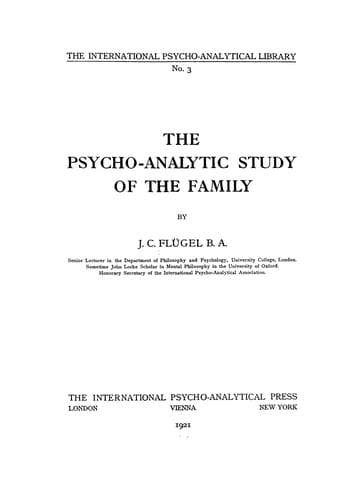
The psycho-analytic study of the familyFlugel, J. C. (John Carl)
Science
The psycho-analytic study of the family
Flugel, J. C. (John Carl)
Families; Marriage; Parent and child; Psychoanalysis
[Footnote 229: We have already (p. 90) given certain examples of that
most common form of incest, the connection of brother and sister. We may
here refer briefly to a few further instances, more especially to those
in which there occurs the more intimate connection between parents and
children. Such instances would seem to have been observed with especial
frequency among the Indians of North America. Thus Samuel Hearne, writing
in 1795, tells us of the Chippewayans that "it is notoriously known that
many of them cohabit occasionally with their own mothers and frequently
espouse their sisters and daughters. I have known several of them who,
after having lived in that state with their daughters, have given them
to their sons and all parties have been perfectly reconciled to it."
("Journey to the Northern Ocean," 1795, 130). Eighty years later Bancroft
tells us much the same of the Kadiaks ("The Native Races of the Pacific
States of North America," 1875, I, 81). An observer of about the same
period writes concerning the eastern tribes of the Tinnehs that "instances
of men united to their mothers, their sisters or their daughters are far
from rare. I have heard among them of two sons keeping their mother as a
common wife, of another wedded to his daughter, while in cases of polygamy
having two sisters to wife is very usual." ("Annual Report of Regents of
the Smithsonian Institution," 1867, 310).
In South America too the practice of incest of this kind would appear
to have been fairly frequently observed. Thus in Brazil the Indians of
the Isanna river "marry one, two or three wives and prefer relations,
marrying with cousins, uncles with nieces, nephews with aunts, so that
in a village all are connected" (A. R. Wallace, "Travels in the Amazon
and Rio Negro," 1889, 352). Commenting on this report, Frazer adds that
"in this preference for marriage with blood relations the Indians of the
Isanna agree with other Indian tribes of South America, especially of
Brazil" ("Totemism and Exogamy," III, 575). Concerning this same part of
the world, another traveller says that "in general it may be asserted
that incest in all degrees is of frequent occurrence among the numerous
tribes and hordes on the Amazon and the Rio Negro" (See Martius, "Zur
Ethnographie Amerikas, zumal Brasiliens," 1867, 116). Of the Peruvian
aborigines we are told by an earlier authority that they "follow their
own desires without excepting sister, daughter or mother. Others excepted
their mother but none else" (Garcilasso de la Vega, First part of the
"Royal Commentaries of the Yncas," trans. by C. R. Markham, 1869-71, I,
58).
Public-domain text, read in full here on John Shaqi.
Reviews
Reviews
No reviews yet
Be the first to share your thoughts on this work.
Elsewhere in the archive
Join the Discussion
Join the discussion
Sign in to leave a comment or review.
Sign InorCreate an account