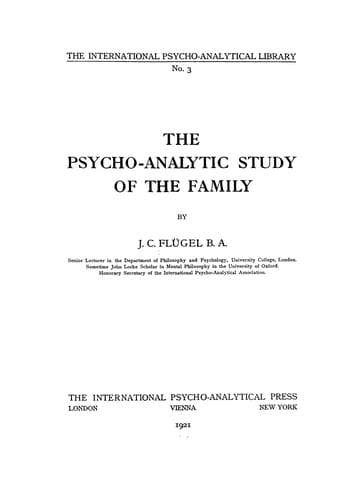
The psycho-analytic study of the familyFlugel, J. C. (John Carl)
Science
The psycho-analytic study of the family
Flugel, J. C. (John Carl)
Families; Marriage; Parent and child; Psychoanalysis
East and Jones in their recent valuable survey of our present knowledge
on the subject[252] conclude quite definitely that inbreeding is not
in itself productive of ill effects, the results of inbreeding in
any particular case depending entirely upon the hereditary qualities
transmitted; so that, although in bad stock the intensification of
undesirable qualities through inbreeding might soon bring about
deterioration, in good stock inbreeding is the surest method of making
the desirable qualities a stable and permanent characteristic of the
race. Nevertheless there are, in the opinion of these writers, certain
advantages of a general nature to be derived from outbreeding connected
principally: (1) with the occurrence of heterosis or hybrid vigour as a
result of outbreeding, (2) with the fact that outbreeding leads to greater
variability between individuals than does inbreeding, thus giving greater
scope for the action of selective agencies and therefore endowing the race
with greater power of adaptation to a changing environment--a factor which
is probably of very considerable importance and which indeed seems to
have been overlooked in a number of previous discussions of the subject,
especially by nonbiological writers.
[Sidenote: and can scarcely account for the intensity of the incest
prohibition]
It thus appears that stress should be laid upon the advantages of
outbreeding rather than upon the supposed ill effects of inbreeding.
Nevertheless we must admit that there exist biological factors of such a
kind as to be capable of influencing the psychological attitude towards
incest in the way that Westermarck's theory requires. But although the
theory that incest prohibition is due to natural selection working on
the _relative_ disadvantages of inbreeding may be correct so far as it
goes, this does not absolve us from the duty of looking elsewhere for
other factors which may have worked in the same direction. For it appears
very doubtful whether the factors we have just been considering can be
regarded as an adequate explanation of incest prohibition as we know it.
If it is the advantages of outbreeding rather than the disadvantages of
inbreeding that are potent; if the evil effects of inbreeding are so
relatively slight as to leave room for doubt as to their nature and even
the fact of their existence; if they are of such kind as to leave healthy
stocks but little if at all affected and to become serious only after long
continuance without admixture of fresh blood from outside (a state of
affairs that can but rarely have occurred); and if they are liable to be
counteracted by a change of locality or of life's conditions (which must
sometimes have occurred, especially among nomadic peoples): then it is not
easy to understand how such a widespread and powerful human characteristic
as the aversion to incest can have arisen _solely_ as the result of
natural selection, working through the bad effects of incest or the
Public-domain text, read in full here on John Shaqi.
Reviews
Reviews
No reviews yet
Be the first to share your thoughts on this work.
Elsewhere in the archive
Join the Discussion
Join the discussion
Sign in to leave a comment or review.
Sign InorCreate an account