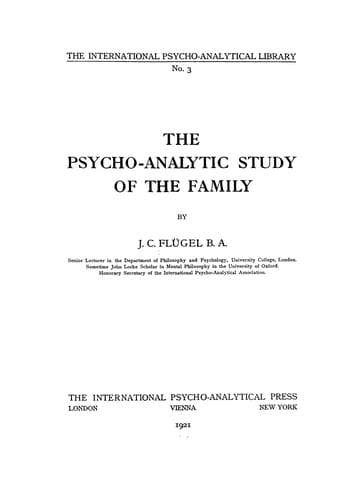
The psycho-analytic study of the familyFlugel, J. C. (John Carl)
Science
The psycho-analytic study of the family
Flugel, J. C. (John Carl)
Families; Marriage; Parent and child; Psychoanalysis
(7) There can be little doubt that there exists a certain degree of
antagonism between the development of strong and permanent ties within
the family and the development of those sentiments and feelings which
bind the individual to the larger social groups, such as the tribe or
nation, or those which make him a prominent, useful and agreeable member
of society--in that family affections conflict in some degree with
gregariousness. This antagonism can be observed in society to-day in such
cases as those in which dependence on, and attachment to, the family
will prevent an individual from easily adapting himself to the wider
environment of school, college or club life, or from becoming "at home"
in the circle of his business, sporting or professional acquaintances.
Similarly, undue concentration of interest or affection on the family will
very frequently prevent the formation of those wider sublimations, some of
which we studied in Chapter XIII, sublimations upon which the successful
working of a large community may often depend. The individual who finds
the satisfaction of all his emotions and desires within the circle of his
family is unlikely to develop to the full those wider interests in his
fellow men and in the social conditions of his age and place, without
which all higher political progress and development become impossible.
At an earlier stage of human society the conflict was very possibly much
more acute. Man, as we have seen, was probably in origin a family, rather
than a social, animal; nevertheless it is the gregariousness of man which
is responsible for the most characteristic features of the progress in
culture which has led to civilisation. Gregariousness has therefore proved
itself a very precious biological possession and natural selection would
be likely to ensure its retention and development in the human mind, thus
affording a strong influence in favour of the repression of those family
affections which might threaten it. It is to some extent in this way
perhaps that there came about that great revulsion against the monogamic
family which is manifested in the totemic age--an age in which the ties
connecting the individual with other members of a larger social group were
developed at the expense of those which attached him to his family, and an
age which elaborated the most complex, far-reaching and intense barriers
against the incest tendencies which are shown in the various systems of
exogamy.
Public-domain text, read in full here on John Shaqi.
Reviews
Reviews
No reviews yet
Be the first to share your thoughts on this work.
Elsewhere in the archive
Join the Discussion
Join the discussion
Sign in to leave a comment or review.
Sign InorCreate an account