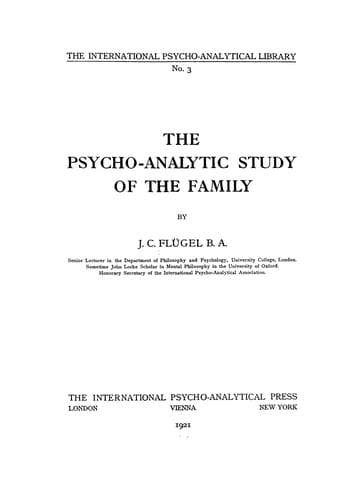
The psycho-analytic study of the familyFlugel, J. C. (John Carl)
Science
The psycho-analytic study of the family
Flugel, J. C. (John Carl)
Families; Marriage; Parent and child; Psychoanalysis
At a later stage of human development, when the foundations of society
were more securely settled, circumstances seem to have permitted something
in the nature of a relaxation of the restrictions on family ties and
family affections, the exogamic rules becoming less strict or less
far-reaching and the family becoming more firmly knit together; this
change being perhaps made possible by the fact that the larger and more
complex social groups of a more developed society no longer came into
such direct conflict with the family as an alternative social unit--the
larger group being now of sufficient size and strength to tolerate the
co-existence of the smaller (or, more strictly speaking, to include the
smaller within itself) without fear of competition or disruption.
Thus, though the urgency of the pressure may very well have varied in
different times and places, it would seem probable that the claims of
social life have constantly exercised some influence in restricting the
interests and affections which centre round the family and have therefore
probably constituted one of the forces which have helped to bring about
that inhibition of the incest tendencies for which we are here trying to
account.
[Sidenote: They conflict also with individual development]
(8) There exists a very similar antagonism between a high degree of family
attachment and the claims of individual development. We have seen in the
earlier chapters the way in which the full unfolding of the individual's
capacities--his ability to maintain himself by his own efforts, his
power of self reliance, of initiative and of independent thought and
action--demand a relaxation of the ties that bind him to his family. It
is true that the relations of an individual to his family which are here
in question are not primarily the erotic ones; still they are everywhere
in contact with these erotic aspects of the family relationship and would
seem to be highly correlated with them--so much so that it is often a
matter of great difficulty to decide where the erotic elements end and the
purely dependence relationships begin[262]. In virtue of this correlation
it would seem that the incest tendencies, when developed or retained in a
high degree, must be inimical to the free growth of individual capacity;
in other words, that those communities in which the incest tendencies
have flourished would, other things equal, consist of less energetic,
self-reliant, and efficient individuals than those in which these
tendencies had been kept within more moderate bounds. Natural selection
would therefore, we might expect, ensure the continuation of those
communities in which the incest tendencies were more repressed. Similarly,
as regards the individuals themselves, it would seem likely that, in
virtue of their greater efficiency, those would survive and prosper who
were able to control and to sublimate their incest tendencies rather than
those in whom these tendencies had free and unrestricted play.
Public-domain text, read in full here on John Shaqi.
Reviews
Reviews
No reviews yet
Be the first to share your thoughts on this work.
Elsewhere in the archive
Join the Discussion
Join the discussion
Sign in to leave a comment or review.
Sign InorCreate an account