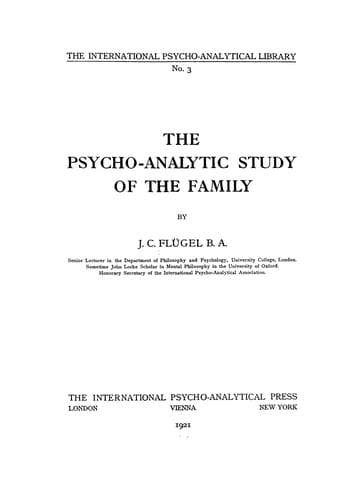
The psycho-analytic study of the familyFlugel, J. C. (John Carl)
Science
The psycho-analytic study of the family
Flugel, J. C. (John Carl)
Families; Marriage; Parent and child; Psychoanalysis
Westermarck would regard the objection to intercourse between those living
together from youth as due to the biological causes discussed above (3).
Without denying the truth of this view, we may venture to suggest that
there perhaps exist psychological causes, which tend to bring about the
same result. Those who live much together must necessarily react in and
to each other's presence in a great variety of ways, involving a very
considerable number of instinctive and habitual mechanisms, the majority
of which are not--or at most are only quite indirectly--sexual in nature,
being concerned for the most part with life preserving activities (_e.
g._ obtaining and preparing food, eating, washing, dressing, acquiring
or practising various branches of skill or knowledge, the carrying on of
professional activities, _etc._). During the greater part of their time
together, the sexual instincts of the persons concerned are therefore
held in check in order that the other mental trends involved in these
various necessary functions may enjoy full play; in fact the reaction
to each other's presence along the lines of these other trends becomes
much more habitual than does reaction along the lines of sexual feeling.
The very constant inhibition of this latter feeling occasioned by the
almost continual preoccupation with everyday affairs, in which those who
live together are equally concerned, is apt to make it difficult for the
inhibition to be entirely removed and for the sexual trends to have free
play, even when opportunity offers; and is therefore calculated to make a
union between those whose lives have long been intimately connected appear
unsuitable or unattractive, quite apart from the operation of any definite
taboo or prohibition; whereas with strangers inhibitions of the kind just
described are far less operative and the sexual impulses can therefore
work without impediment.
[Sidenote: and especially by hostile tendencies]
A further factor which may reinforce the foregoing is connected with
the actual hostility (conscious or repressed) that so frequently exists
between those whose lives and interests are connected. As we have already
had occasion to see, the competition that exists between members of
the same family is almost bound to engender some degree of hostility;
and this hostility (even if in later life it be quite indiscernible to
consciousness) will add its weight to any force which tends to inhibit
love of the person towards whom hostility is felt.
Here then we have two factors, which, though not peculiar to incestuous
relationships, nevertheless very probably contribute a certain share of
influence to the sum total of the forces productive of the aversion to
incest[263].
[Sidenote: The incest tendencies are also affected by the general sexual
inhibitions]
Public-domain text, read in full here on John Shaqi.
Reviews
Reviews
No reviews yet
Be the first to share your thoughts on this work.
Elsewhere in the archive
Join the Discussion
Join the discussion
Sign in to leave a comment or review.
Sign InorCreate an account