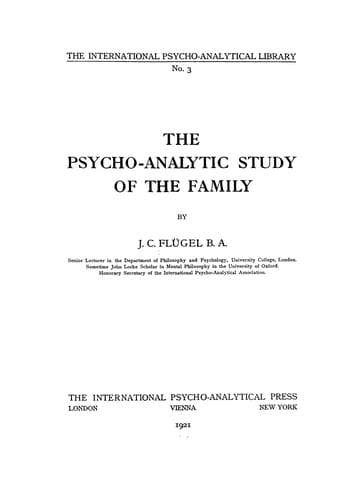
The psycho-analytic study of the familyFlugel, J. C. (John Carl)
Science
The psycho-analytic study of the family
Flugel, J. C. (John Carl)
Families; Marriage; Parent and child; Psychoanalysis
(10) The incestuous tendencies with which we are here concerned are, as we
have amply seen, among the earliest manifestations of sexuality (in the
wide sense of this term commonly employed by psycho-analysts) and, like
most other manifestations of this aspect of human nature, suffer from the
general repression to which sexuality in all its more direct expressions
is habitually subject. It is no doubt true that the incestuous direction
of the youthful sexual impulse itself contributes in very appreciable
measure to the conditions which bring about this general repression, and
that this repression is therefore to some extent an effect rather than
a cause of the incest inhibition. Nevertheless it would seem at least
equally certain that incest inhibition is far from being responsible for
the whole of sexual repression and that the latter does react powerfully
in certain respects upon the former, so that the existence of a general
tendency to the repression of all manifestations of the sexual instinct
may be regarded as constituting an additional factor in the inhibition of
incestuous affection for which we have been trying to account[264].
[Sidenote: Thus the circumstances of human life are responsible for the
mental conflicts that centre round the incest tendencies]
We have now studied some of the principal factors which, it seems, may
have had some influence in producing the tremendous conflicts in the
human mind which centre round the family. In so far as we have been
correct in our analysis of these factors, it would appear that there are
strong influences, both in the individual and in the race, which work
both positively and negatively in regard to those aspects of love and
hate which constitute the Œdipus complex. The existence of the mental
struggles which this complex inevitably brings in its train may therefore,
on a wider view, appear less startling than on a first approach. Both
the human individual and the human race are subject to conditions, some
of which favour one mode of response, some of which are best reacted
to by a contrary or at least an antagonistic type of behaviour. Owing
to the inherent limitations of the human mind at the unconscious and
primitive levels--its difficulty in overcoming habits that have once been
formed, its tendency to give expression simultaneously to incompatible
impulses, its relatively small power of creating distinctions and
differentiations--it is inevitable that the different tendencies which
are thus created and aroused should frequently come into conflict. It
would seem to be more especially the function of consciousness however
to produce a clear distinction between different situations and thus to
facilitate nicer adaptations of conduct than would otherwise be possible.
By understanding his own impulses and the true nature of the situations
which have called them forth and to which they are adapted, man becomes
to some extent master of his own fate and can rise above the blind level
Public-domain text, read in full here on John Shaqi.
Reviews
Reviews
No reviews yet
Be the first to share your thoughts on this work.
Elsewhere in the archive
Join the Discussion
Join the discussion
Sign in to leave a comment or review.
Sign InorCreate an account