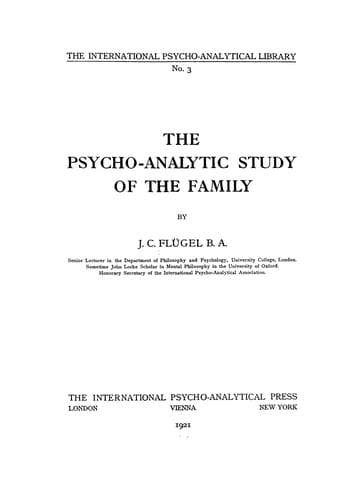
The psycho-analytic study of the familyFlugel, J. C. (John Carl)
Science
The psycho-analytic study of the family
Flugel, J. C. (John Carl)
Families; Marriage; Parent and child; Psychoanalysis
[Footnote 253: Supposing that natural selection does exercise some
influence of the kind indicated, such influence does not of course,
here any more than elsewhere, necessarily imply any appreciation of the
nature of the causes at work. On the contrary, as some authorities have
pointed out, it is scarcely possible to ascribe to primitive man any
conscious realisation of the ill effects of inbreeding (if these exist).
These ill effects manifest themselves much too slowly to be observed by
the savage with his relatively short memory and his lack of interest in
remote events, especially when, as has often been the case, there has been
uncertainty as to the nature of paternity. Even if the savage were able
to realise the nature of this hereditary influence, it is pretty clear
that his actions and feelings would be but little affected thereby, for it
is one of the most general characteristics of the primitive mind that it
takes but small account of distant consequences, whereas Eugenics involves
the appreciation of such consequences in a high degree.]
[Footnote 254: "Elements of Folk Psychology", 151.]
[Footnote 255: "Studies in Ancient History" (2nd. ed.) 160.]
[Footnote 256: "Principles of Sociology", I, 619.]
[Footnote 257: "The Origin of Civilisation", 135 ff.]
[Footnote 258: "Indisches Ehe- und Familienrecht", _Zeitschrift für
vergleichende Rechtswissenschaft_, III, 1882, 361.]
[Footnote 259: Atkinson and Andrew Lang, "The Primal Law."]
[Footnote 260: A full discussion of these theories will be found in
Westermarck's "History of Human Marriage" and Frazer's "Totemism and
Exogamy".]
[Footnote 261: Whatever real truth there may be in this argument, we
must not fail to bear in mind that it is admirably adapted for use as
a "rationalisation", _i. e._ the fear of evil consequences (dysgenic
or other) from marriages between young and old may well be a conscious
(and, in a sense, artificial) substitute for the unconscious aversion to
such marriages on the ground of their being an indirect expression of
incestuous desires. We must therefore be on our guard against the tendency
to overemphasise this argument in the absence of adequate objective
evidence.]
[Footnote 262: It is round this point of course, as we have above shown,
that the differences of opinion between Freud and Jung have largely
centred.]
Public-domain text, read in full here on John Shaqi.
Reviews
Reviews
No reviews yet
Be the first to share your thoughts on this work.
Elsewhere in the archive
Join the Discussion
Join the discussion
Sign in to leave a comment or review.
Sign InorCreate an account