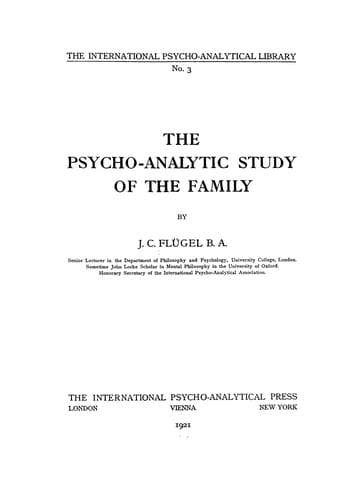
The psycho-analytic study of the familyFlugel, J. C. (John Carl)
Science
The psycho-analytic study of the family
Flugel, J. C. (John Carl)
Families; Marriage; Parent and child; Psychoanalysis
Thus it will by now have become amply clear, what, in the main, are
the pitfalls to avoid in the course of family life, and what are the
chief ends which it is desirable to seek. The weaning of the child from
the incestuous love which binds it to the family (together with the
secondary hatred which this love may entail) and the gradual loosening
of the psychological, moral and economic dependence of the individual
on the family have revealed themselves as the two chief aspects of the
task with which the ethical treatment of our subject has to deal. The
considerations brought forward in the last three chapters have shown that
human beings are subject to two opposing tendencies in these respects--one
of these tendencies uniting the individual closely to the family, the
other separating him sharply from it; both tendencies being conditioned
by psychological and biological factors of fundamental significance. It
is the duty of a sane and reasonable ethics of the family to indicate the
most satisfactory solution of the conflict which these opposing tendencies
engender, giving such scope to either tendency as may be necessary for it
to fulfil its essential function in the life of the individual and the
race.
[Sidenote: The tendencies towards the family more primitive than those
away from the family]
[Sidenote: The latter more often require artificial aid]
Our treatment of the subject during the greater part of this book,
following as it does the actual findings of those who have been brought
face to face with these tendencies in the course of their endeavours
to understand and cure the disorders of mental growth and personality,
has no doubt conveyed to some extent the impression that it is the
first mentioned tendency--that which draws the individual _towards_
the family--which is most often found in excess, and has therefore most
frequently to be restrained, while it is the tendency _away_ from the
family which is most often deficient in strength or in development, and
which therefore most frequently requires artificial stimulation and
encouragement. This impression is indeed one that is inevitably conveyed
by a careful study of the knowledge that we at present possess upon the
subject. In whichever direction we look, Man's chief handicap, as regards
those aspects of his mind which here concern us, would appear to consist
in an undue strength, or at any rate an undue persistence, of an infantile
attitude towards the family. This would seem to indicate that the tendency
towards the family is probably both ontogenetically and phylogenetically
the older and more fundamental of the two, and that the tendency away
from the family is not yet sufficiently deeply rooted or assimilated in
the human mental constitution to be able to assert itself with sufficient
force in the manner and direction that successful biological adjustment
would require.
[Sidenote: But the former are biologically deeper and more essential]
Public-domain text, read in full here on John Shaqi.
Reviews
Reviews
No reviews yet
Be the first to share your thoughts on this work.
Elsewhere in the archive
Join the Discussion
Join the discussion
Sign in to leave a comment or review.
Sign InorCreate an account