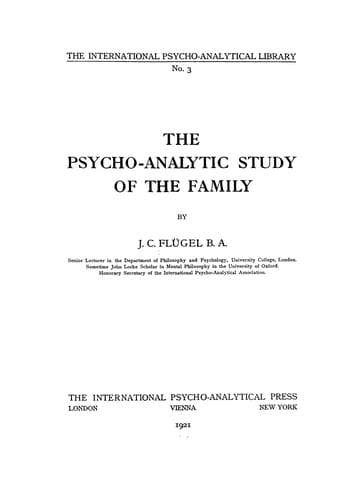
The psycho-analytic study of the familyFlugel, J. C. (John Carl)
Science
The psycho-analytic study of the family
Flugel, J. C. (John Carl)
Families; Marriage; Parent and child; Psychoanalysis
Nevertheless, if this is so, the mere fact that the tendency towards the
family is thus in some respects prior to, and more fundamental than,
its antagonist, would indicate that it is based upon biological and
psychological conditions and requirements that are correspondingly more
primitive and therefore more essential. We have seen in effect that the
causes which have led to the strong attachment of the individual to the
family are probably connected with certain necessary conditions of human
growth and development--the long period of helplessness and immaturity,
the dependence upon others (and especially the parents) for the very
necessaries of life, the need to learn from others, the need for an early
arousal and outward direction of the love impulse, _etc._ The causes which
underlie the tendency away from the family--such as the need of casting
off the dependence on the family in order to attain a full measure of
individuality, the antagonism between the family attachments and the
wider social bonds, the value of sexual sublimation for the advance of
culture, the possible dysgenic effects of inbreeding--these are in the
main connected with less pressing and immediate conditions of existence;
conditions which are no doubt of great importance for the ultimate fate
of the individual and the race, but which are not essential for the
immediate preservation and growth of the individual in his early life, and
which frequently involve a diminution rather than an increase in immediate
benefit or pleasure; representing, as they do, biological values of a
higher and more complex order, which come into operation only when those
of a more primitive kind have been attained.
[Sidenote: The family attachments must be outgrown rather than destroyed]
Public-domain text, read in full here on John Shaqi.
Reviews
Reviews
No reviews yet
Be the first to share your thoughts on this work.
Elsewhere in the archive
Join the Discussion
Join the discussion
Sign in to leave a comment or review.
Sign InorCreate an account