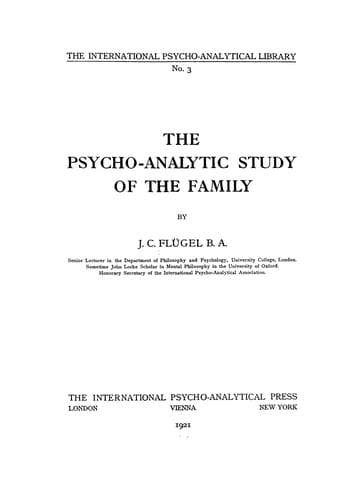
The psycho-analytic study of the familyFlugel, J. C. (John Carl)
Science
The psycho-analytic study of the family
Flugel, J. C. (John Carl)
Families; Marriage; Parent and child; Psychoanalysis
The same result emerges if we consider the matter, not from the point of
view of sociology, but from that of an enlightened system of morality.
The evidence available shows, for instance, that little if any harm is
likely to ensue from the marriage of first cousins, so long as the stock
is a healthy one: much the same is probably true as regards the marriage
of half brother and half sister or even full brother and sister. Our
condemnation of such unions is due to influences emanating from the
repression of the incest tendencies, and not to any sound appreciation or
experience of their ill effects; and in so far as the taboos consequent
upon repression give way to more balanced moral judgments based on a real
understanding of the issues involved (and this is the general tendency of
ethical development), the disapproval of these unions between near kin
will be continued only in so far as real dangers are to be apprehended
from them. Among such real dangers there may be found the biological
one of the possibility of inferior offspring, especially in the case of
families with marked hereditary defects, and the psychological one of too
little emancipation from the family influences, with all the consequences
that this may involve. As regards this latter, however, it will have to
be recognised that complete emancipation may often be beyond the bounds
of possibility and that it is often advisable to permit some degree
of indulgence to overstrong unconscious tendencies, so long as this
indulgence is not too persistent or too definitely pathological.
FOOTNOTES:
[Footnote 265: It would seem that children who have never known their
parents or any normal parent substitutes, such as those who are brought up
entirely in orphanages and other institutions, nevertheless do actually
find corresponding objects on to whom their parent-regarding tendencies
can be directed; if not in reality, at least in imagination--imagination
that tends to find a real equivalent as soon as a suitable object presents
itself. This is amusingly and instructively illustrated in Jean Webster's
recently successful book and play "Daddy Long Legs".]
[Footnote 266: It is scarcely necessary to point out the Neo-Malthusian
bearings of these considerations. They add one more argument to the many
that already exist in favour of the practice of birth-control, which
is now adopted by the more cultured classes of nearly all civilised
communities--a practice the ethical justifications of which are becoming
constantly more manifest.
Public-domain text, read in full here on John Shaqi.
Reviews
Reviews
No reviews yet
Be the first to share your thoughts on this work.
Elsewhere in the archive
Join the Discussion
Join the discussion
Sign in to leave a comment or review.
Sign InorCreate an account