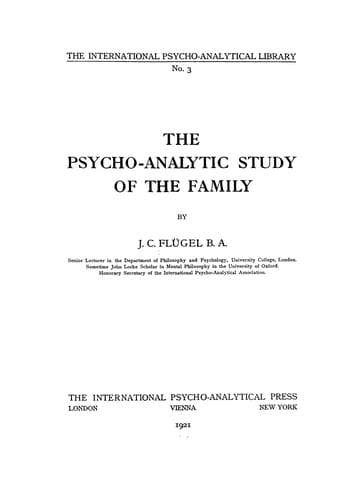
The psycho-analytic study of the familyFlugel, J. C. (John Carl)
Science
The psycho-analytic study of the family
Flugel, J. C. (John Carl)
Families; Marriage; Parent and child; Psychoanalysis
The duty of the parents or their substitutes in the direction of gradually
weaning the child from his initial condition of dependence has however
received less adequate recognition nor has the difficult and delicate
nature of this duty been sufficiently appreciated. On the economic and
social sides indeed it is admitted that it is incumbent upon parents to
provide their children with the means of earning their living and of
taking their place generally among their social equals; though with regard
to girls the views as to what was necessary as regards education for
these purposes has, up till comparatively recently, often been lamentably
narrow. In this country there is even now in many quarters a failure
to realise the full nature of parental responsibilities with regard to
daughters; much less financial provision being frequently made in their
case, both for higher and professional education and for the expenses
incidental to marriage, than in the case of sons; lack of adequate
provision in these respects inevitably tending of course to produce an
undue degree of dependence--economical and moral--on the parents.
[Sidenote: especially as regards the psychological aspect of this tie]
If, on the economic side, the duty of weaning children from their
primitive dependence on the family is thus not yet always fully
recognised, the recognition of the corresponding duties on the
psychological side is still less complete. Parents are often unwilling
to abandon the jurisdiction and control which they have been accustomed
to exercise over their children and which may have become very pleasant
to them, both as providing an agreeable source of interest and as
ministering to their sense of power. Often too in the beginning it may be
easier for them to help their children than to let the latter learn to
help themselves. Not infrequently also they are directly or indirectly
encouraged in this course by the children themselves, who, out of laziness
or failure in initiative, prefer that their lives should be regulated by
their parents rather than that they should make the effort and take on the
responsibility of regulating it themselves. Sometimes, moreover, parents
are unwilling to relinquish the management of their childrens' lives for
fear of the disasters that may overtake these latter through ignorance and
inexperience; or again because of an exaggerated tenderness which makes
them loth to abandon those manifestations of affection which parental
assistance may imply. It must be understood however that none of these
motives--powerful though some of them may be--provide an adequate excuse
for the omission to carry out the weaning process, which, as we have seen,
is of such vast importance for the development of the full capacities
of the individual. It can scarcely be too frequently emphasised that
parents who bring their children up without regard to the necessity of
this emancipation are guilty of a very serious neglect of their childrens'
Public-domain text, read in full here on John Shaqi.
Reviews
Reviews
No reviews yet
Be the first to share your thoughts on this work.
Elsewhere in the archive
Join the Discussion
Join the discussion
Sign in to leave a comment or review.
Sign InorCreate an account