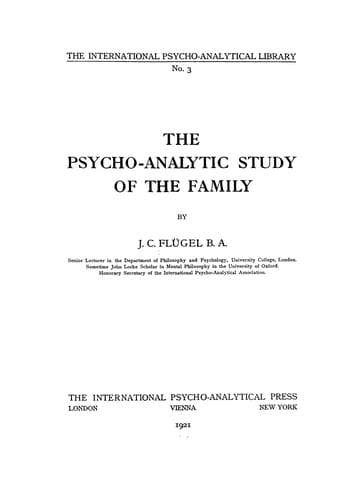
The psycho-analytic study of the familyFlugel, J. C. (John Carl)
Science
The psycho-analytic study of the family
Flugel, J. C. (John Carl)
Families; Marriage; Parent and child; Psychoanalysis
On the other hand, it is perhaps necessary to emphasise the advantages to
be derived from the formation, by each individual member of the family, of
his own friendships and companionships as distinct from those which are,
so to speak, found for him by his family. Thus, it is far from desirable
that members of the same family should always accompany one another to
social gatherings, places of entertainment or instruction, or on visits
to friends. On the contrary, they will often benefit by being freed from
each other's society on these occasions, and no restraints should, as a
rule, be placed upon habits of independent occupation or enjoyment or upon
choice of associates. Nor should the individual members of the family
be expected on every occasion to render a detailed account of all their
activities outside the family circle, nor to confine these activities
rigorously to certain days or hours. Much family friction can often be
avoided by the simple process of bestowing a latchkey! As regards extreme
cases, moreover, it should be realised that wherever there is unusual
difficulty in the relations between an individual and the other members of
his family, a removal from the family environment is the surest, perhaps
the only, method of avoiding disaster.
Above all it is necessary, throughout the process of development and
education, to aim at the attainment of a due measure of self-respect and
self-reliance, avoiding the pitfalls of too great self-satisfaction on
the one hand and an unreasonable sense of inferiority on the other. It
is here, more than elsewhere, that considerable differentiation in the
treatment of individuals is required. Those who are inclined to be too
well pleased with themselves will usually benefit by a somewhat rougher
treatment, and will need to have their deficiencies brought home to them.
Those who lack self-confidence, or who have an unduly low estimate of
their attainments or capacities, will need encouragement and reassurance.
In the former case some very appreciable degree of parental authority may
be called for, in the latter any treatment savouring of harshness is for
the most part tragically out of place.]
INDEX
Abandonment of infantile tendencies, 83.
Abdication, 131.
Abnormalities of development, 48 ff., 61 ff., 88 ff., 102, 188,
191, 218, 219, 241.
Aborigines, 91, 140, 194 ff., 229.
Abortion, 160.
_Abraham, K._, 51, 92, 106, 148, 150, 185.
_Ach, N._, 7.
Acheron, 69.
Adam, 148.
Adaptation to reality, 68, 215, 216, 219 ff.
_Adler, A._, 14.
Admiration, 98, 110, 123, 124, 139, 186, 227.
Adolescence, 51, 149, 192, 233.
Adonis, 72.
Africa, 194, 197.
Age:
As a factor in love, 28 ff., 89, 106, 207, 208.
Classes, 87.
Old, 239 ff.
Aged, care of, 240.
Agoraphobia, 67.
Agriculture, 147.
All-Father, 136, 137.
_Alma Mater_, 125.
"Alternation of generations", 63.
Altruism, 188.
Public-domain text, read in full here on John Shaqi.
Reviews
Reviews
No reviews yet
Be the first to share your thoughts on this work.
Elsewhere in the archive
Join the Discussion
Join the discussion
Sign in to leave a comment or review.
Sign InorCreate an account