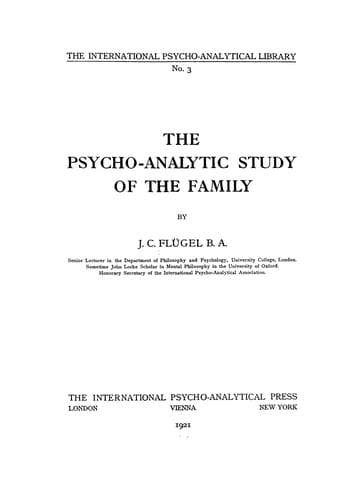
The psycho-analytic study of the familyFlugel, J. C. (John Carl)
Science
The psycho-analytic study of the family
Flugel, J. C. (John Carl)
Families; Marriage; Parent and child; Psychoanalysis
that life's concluding chapter has shaped itself for them in a form as
satisfactory as any which it is granted to human nature to enjoy.
[Sidenote: Conclusion]
With these considerations regarding old age we may appropriately end. The
subject of the human family is a mighty theme, of which no full treatment
has been attempted here. If I have illumined certain aspects of the
subject, if I have led the reader to realise something of the depth and
complexity of the problems involved and of their vast importance for human
weal and woe, nay, even for human existence, I shall have accomplished
all, or more than all, that I set out to do. We have seen that, just as on
the biological side the family is an essential factor in the development
and preservation of the human race, so too on the psychological side, the
thoughts, feelings and impulses that centre round the family belong to
the most intimate and fundamental part of Man's spiritual nature. If we
are to understand this nature and to control and mould it wisely in order
that we may achieve those ends in life which seem to us desirable, it is
very necessary that we should have a full and accurate knowledge of the
way in which the mind is influenced by, and in its turn reacts upon, the
forms, circumstances and conditions of the human family. It is this which
makes the subject of this little volume one of such supreme importance.
FOOTNOTES:
[Footnote 270: As regards the actual steps which should be taken to secure
this gradual emancipation of the growing individual from the influence and
control of his family and parents, it is perhaps superfluous (and in any
case inappropriate in a book of this scope) to enter fully into details
here. It will be sufficient to indicate a few very obvious directions in
which the general principles here referred to may find application. Thus,
it is clear that children should from early years have opportunity of
acquiring experience in the use of money, having at first small sums at
their disposal, with larger amounts as they advance in age. They should
also have experience--at first perhaps occasionally and then regularly--in
purchasing their own clothes, books, writing materials and other personal
requirements. The ability to travel alone, to find one's way in strange
places and to mix with unknown people is also one that should be acquired
early, leading, as it tends to do, to the development of resourcefulness
in dealing with new situations and with varieties of human character.
In view of modern educational movements, it is perhaps hardly necessary
to point out in this connection the desirability of considerable (and
eventually of complete) freedom in the choice of studies, of occupations
and of career. The need for toleration in religious and political matters
is also nowadays one that is becoming recognised.
Public-domain text, read in full here on John Shaqi.
Reviews
Reviews
No reviews yet
Be the first to share your thoughts on this work.
Elsewhere in the archive
Join the Discussion
Join the discussion
Sign in to leave a comment or review.
Sign InorCreate an account