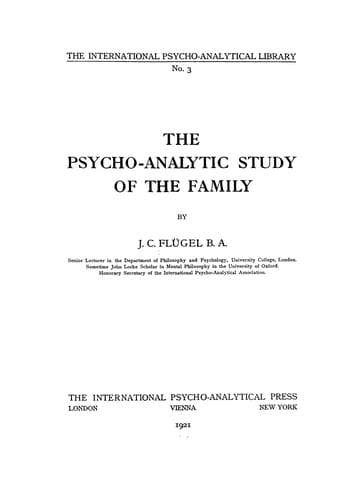
The psycho-analytic study of the familyFlugel, J. C. (John Carl)
Science
The psycho-analytic study of the family
Flugel, J. C. (John Carl)
Families; Marriage; Parent and child; Psychoanalysis
In these considerations we have throughout laid the principal emphasis
upon the desirability and necessity of the acquirement of self help
and self guidance on the part of the individual. This has been chiefly
because the results of psycho-analytic work have indicated that the
danger lies most frequently in the direction of too great, rather than
of too little, dependence on the efforts and guidance of the parents or
their substitutes. This fact must not however be allowed to blind us to
the existence of a danger of an opposite character--that of a too rapid
or too complete emancipation from parental authority. Such emancipation
would, it is true, seem to occur seldom enough as a direct consequence
of the unfolding of the child's individual capabilities and desires: the
attitude of dependence necessarily adopted in childhood and early youth,
together with the respect almost inevitably inspired in the very young by
the greater power, knowledge and experience of the parents, effectually
prevents this in the majority of cases. But it may easily come about as
the result of a reaction against a too insistent or despotic use of the
parental power. Parents who are too severe, too repressive, or even too
careful, as regards the upbringing of their children, will--especially if
the latter happen to possess strong tendencies to self-assertion--often
bring about a state of revolt against their own authority, in which all
that may be good and wise in that authority is deliberately neglected
or condemned, since the children have grown to look upon their parents
as tyrants and taskmasters rather than as helpers and protectors. A
stern or bullying father, a nagging or over anxious mother, will thus
frequently produce a rebellious son or daughter, who will respect neither
the advice or commands of the parents themselves nor those of their
(mental) substitutes in later life. Such children, as they grow up, may
be prevented from profiting to the desirable extent by the wisdom and
experience of past ages, as represented in the traditions and dictates
of authority, and (what is worse) may even become unfit for taking their
place in any scheme of harmonious social life, through inability to
submit to the degree of individual subordination, which such social life
inevitably demands[31].
[Sidenote: The wider social bearings of this subject]
Public-domain text, read in full here on John Shaqi.
Reviews
Reviews
No reviews yet
Be the first to share your thoughts on this work.
Join the Discussion
Join the discussion
Sign in to leave a comment or review.
Sign InorCreate an account