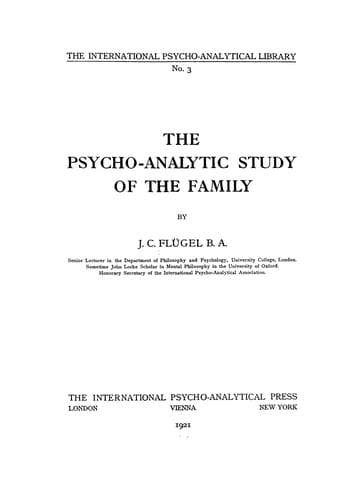
The psycho-analytic study of the familyFlugel, J. C. (John Carl)
Science
The psycho-analytic study of the family
Flugel, J. C. (John Carl)
Families; Marriage; Parent and child; Psychoanalysis
In the previous chapters we have seen that in the earliest stages of
development the most important psychic reactions of the child (so far as
they concern us here) are those connected with the parents. At a later
stage, the tendencies and emotions originally centering in the parents
undergo (under the influence of Repression) a process of Displacement
on to other persons and objects. This important fact in the process of
development may serve us as a preliminary basis of classification in
dealing with the numerous variations which we shall encounter. We shall
first undertake a review of the more primitive types of variation in which
the abnormal elements are directly connected with the child's relations to
its parents, passing on subsequently to the more complex types in which a
well marked displacement of the child's original feelings has taken place,
as the result of which the abnormality is no longer directly connected
with the parents themselves but with a substitute for these.
[Sidenote: Abnormalities and variations in the parent--regarding
tendencies]
As regards the first class, the general nature of the psychic defects
which may be met with is, in the main, familiar to us from our
consideration of the early stages of normal development. If any of the
features of the individual's relations to his parents which we there
passed in review--the love and hate aspects of the Œdipus complex, the
dependence on the efforts of the parents as regards self maintenance and
preservation, the general obedience to, and reliance on, the authority of
the parents--should persist at a relatively advanced age in anything like
their original quality and intensity, then there exists one of the defects
in question. Not that any of these features will be found to manifest
themselves (except perhaps on rare occasions) in exactly their original
form and manner. The general mental and moral growth of the intervening
years usually ensures that many of these features shall have undergone a
process of repression in virtue of which they are no longer permitted to
express themselves fully and openly in consciousness. More especially is
this the case with regard to the love and hate elements in the psychic
relationship of the individual to his parents. These will seldom manifest
themselves quite openly and directly though they may attain to indirect
expression in dreams, neurotic symptoms, fancies and (as Rank has so
abundantly shown) in works of art. The psycho-analytic treatment of these
productions has shown, however, that the original tendencies may persist
in their crude form in the unconscious; and thence may exercise a profound
influence on character and mental life.
[Sidenote: Fixation at the stage of parent love]
Public-domain text, read in full here on John Shaqi.
Reviews
Reviews
No reviews yet
Be the first to share your thoughts on this work.
Join the Discussion
Join the discussion
Sign in to leave a comment or review.
Sign InorCreate an account