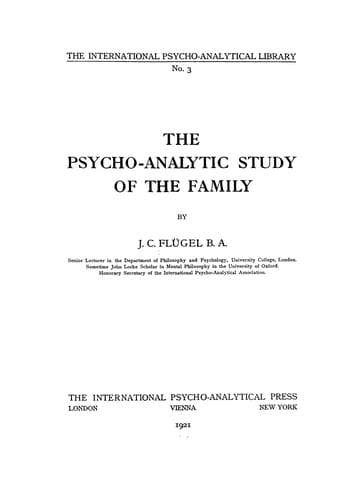
The psycho-analytic study of the familyFlugel, J. C. (John Carl)
Science
The psycho-analytic study of the family
Flugel, J. C. (John Carl)
Families; Marriage; Parent and child; Psychoanalysis
[Footnote 35: Even if marriage is at first apparently successful, it may
be unable to stand the strain of circumstances which would present little
or no difficulty in the absence of parent fixation. Thus in a case known
to me, after a happy honeymoon spent near home, a wife proved unable
to accompany her husband to a distant locality, where business affairs
necessitated his residence but (in spite of his protests and entreaties)
turned back while on the journey and returned to live with her parents. It
appeared that she had very seldom left home before her marriage, having
been brought up by kindly but indulgent parents, as regards whom there
was a strong emotional fixation. In her youth she had only travelled once
without her parents, being then so miserably unhappy that she begged to be
sent home again as soon as possible.]
[Footnote 36: _Cp._ especially Ferenczi, "Contributions to
Psycho-Analysis," 250.]
[Footnote 37: In the case of a woman, the record of whose analysis was
kindly shown to me by Dr. E. M. Cole, there appears to have been a
complete father fixation (with corresponding hatred of the mother) at one
level and at a lower and more unconscious level an equally complete mother
fixation (with all the indications of an "inverted" Œdipus complex), the
two levels being characterised by a predominance of heterosexual and
homosexual tendencies respectively.]
[Footnote 38: In three cases of homosexual tendencies in men which I have
recently had the opportunity of studying, the desire to be used by the
father as a sexual objective was quite clearly apparent. _Cp._ Freud's
"Aus der Geschichte einer infantilen Neurose." Sammlung kleiner Schriften
zur Neurosenlehre. IV. 578 ff.]
[Footnote 39: "Contributions to Psycho-Analysis," 250 ff.]
[Footnote 40: _Cp._ Rank, "The Myth of the Birth of the Hero," 1913.]
[Footnote 41: Freud, "Beiträge zur Psychologie des Liebeslebens,"
_Jahrbuch für psychoanalytische und psychopathologische Forschungen_,
1910, II, 389.]
[Footnote 42: See Rank, _op. cit._, also the more recent treatment by the
Questionnaire method by Edmund S. Conklin, "The Foster-Child Fantasy,"
_American Journal of Psychology_, 1920, XXXI, 59.]
[Footnote 43: There can be no doubt that this is a factor of very
considerable significance. The child projects on to its parents its own
desires, ambitions and aspirations, thus finding compensation for the
gradual realisation of its own deficiencies, limitations and want of
power (in much the same way as parents in their turn find consolation
for their own disappointments in contemplating the successes--real or
anticipated--of their children. _Cp._ below Ch. XIV.). In this way certain
of the Narcissistic impulses find displaced expression in the idealisation
of the parents and the exaggeration of their powers--a factor which
probably plays a part of great importance in the Psychology of Religion
(_Cp._ below Ch. XIII.).
Public-domain text, read in full here on John Shaqi.
Reviews
Reviews
No reviews yet
Be the first to share your thoughts on this work.
Elsewhere in the archive
Join the Discussion
Join the discussion
Sign in to leave a comment or review.
Sign InorCreate an account