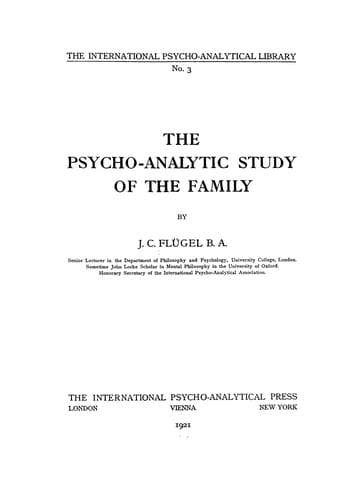
The psycho-analytic study of the familyFlugel, J. C. (John Carl)
Science
The psycho-analytic study of the family
Flugel, J. C. (John Carl)
Families; Marriage; Parent and child; Psychoanalysis
We have now reached a point in our discussion at which we may perhaps
profitably pause awhile to consider a group of phantasies, which, on
account of their widespread occurrence and curious character, would
seem to deserve some very special attention at the hands of the
psychologist and anthropologist. The phantasies in question are those
which psycho-analysts have found to cluster round the idea of returning
to the mother's womb and of resuming there the intra-uterine life enjoyed
by the child in the pre-natal stages of its existence,--an idea which
is discoverable (usually of course in a symbolic form) in many myths,
legends, dreams, reveries and symptomatic actions. It is very frequently
associated with the further idea of birth or re-birth, and it is in this
form that the phantasy was first described by Freud[46]. In consciousness
this phantasy of returning to the womb may clothe itself as an idea of
being in an enclosed, dark, solitary or inaccessible place, safe from
outside dangers or disturbances. Its influence can probably be traced in
the pleasure that many persons find in the retirement to small islands,
mountain tops or other places isolated from the rest of the world, in
the "cosiness" of small rooms or closets or in the comfort which may be
experienced in snuggling under the bed-clothes in the presence of real
or imaginary danger[47]. Sleep itself, in its power of withdrawing the
individual from the outer world and in its unmistakable approximation to
the pre-natal condition of body and mind, may, from certain points of
view, be regarded as an exemplification of the same tendency[48] as may
also possibly hypnosis. In certain forms of insanity the tendency may
show itself quite clearly even in waking life, the patient withdrawing
himself as far as possible from all environmental influences and sometimes
adopting a characteristically foetal posture,--a posture which, it
should be noted, is often adopted even by normal persons during sleep.
More moderately and within the bounds of sanity, it may show itself in
a relative degree of retirement from the world, as in the life followed
in Christian monasteries or nunneries, or--more clearly--in the still
more isolated existence of many Buddhist monks and devotees, some of whom
will live for years in caves or other dark and secluded spots, almost
entirely cut off from human intercourse and from the light and bustle of
the outside world. In a more distinctly neurotic form again, its influence
may be traced in agoraphobia--the fear of open spaces--or negatively
(the reaction against the tendency predominating) in its opposite,
claustrophobia--the fear of narrow, confined rooms or places--or in the
morbid dread of being buried alive.
[Sidenote: Meaning of this desire]
Public-domain text, read in full here on John Shaqi.
Reviews
Reviews
No reviews yet
Be the first to share your thoughts on this work.
Elsewhere in the archive
Join the Discussion
Join the discussion
Sign in to leave a comment or review.
Sign InorCreate an account