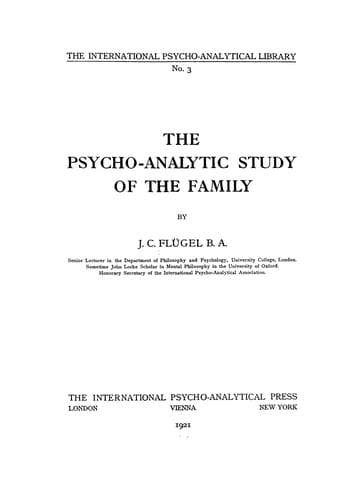
The psycho-analytic study of the familyFlugel, J. C. (John Carl)
Science
The psycho-analytic study of the family
Flugel, J. C. (John Carl)
Families; Marriage; Parent and child; Psychoanalysis
In all these manifestations the dominant motive would seem to consist in a
desire to escape from the troubles, labours, anxieties and excitements of
the world, to a place where there is rest and peace with no necessity for
effort. Now there can be no doubt that the intra-uterine life of the child
represents by far the nearest approach to such a blissful state of repose
that is ever enjoyed by us during any period of our earthly existence. In
this pre-natal life the child lives effortlessly, free from danger and
with all its needs provided; in striking contrast to post-natal (and more
especially adult) life, where in general the stern rule holds that "if any
will not work, neither shall he eat", and where the individual constantly
finds his strength all too small to do battle with the formidable
obstacles that so often stand in the way of the fulfilment of his desires.
[Sidenote: Difficulty of the process of adaptation to reality]
It is, as Ferenczi[49] has been at pains to show, only in so far as we
free ourselves from the habits, associations and implications of this
pre-natal life that we can learn to achieve the fulfilment of our wishes
by taking the necessary steps to bring about their accomplishment in the
outer world, instead of endeavouring to make the outer world conform
to our desires by the shorter and easier method of imagination and
delusion. In the earliest stages of our existence we are in a sense indeed
omnipotent, inasmuch as provision is made for all our requirements and
desires as it were automatically and without the necessity for effort on
our own part. In early childhood this state persists in some degree, the
child's wants being, to a large extent, fulfilled by others as soon as he
indicates their nature. This power of automatically bringing about the
satisfaction of our needs is destined to undergo a continually increasing
degree of restriction, as childhood changes through adolescence to
maturity; a greater individual adaptation to reality being achieved at
the cost of greater individual effort and of the loss of the childish
confidence in our ability to achieve our ends by the simple process of
desiring their achievement. Under the stresses and difficulties of life on
this developed plane, it is only too easy to sink back to the earlier and
simpler state where less effort is demanded, and if we retrace our steps
in this direction as far as they will lead us, we return eventually to the
primitive condition of our pre-natal life. It is thus, apparently, that a
return to this earliest stage of our existence has come to stand as the
supreme goal and object of all desire to escape from the turmoil, labour
and conflict which developed life inevitably brings in its train.
[Sidenote: Life before birth and life after death]
Public-domain text, read in full here on John Shaqi.
Reviews
Reviews
No reviews yet
Be the first to share your thoughts on this work.
Elsewhere in the archive
Join the Discussion
Join the discussion
Sign in to leave a comment or review.
Sign InorCreate an account