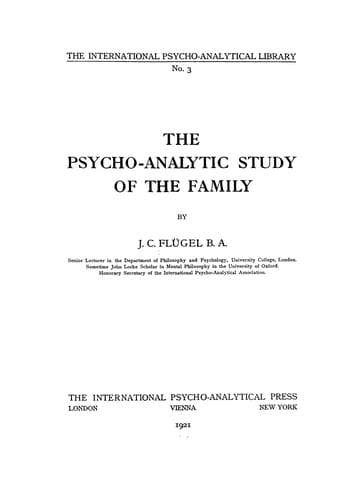
The psycho-analytic study of the familyFlugel, J. C. (John Carl)
Science
The psycho-analytic study of the family
Flugel, J. C. (John Carl)
Families; Marriage; Parent and child; Psychoanalysis
If the idea of life within the mother's womb is in this way closely
associated with the desire for cessation of toil and striving, it is not
surprising that we frequently find it brought into connection with the
most striking example of such cessation with which we are acquainted, _i.
e._ the complete stoppage of all vital activities at death. As a matter
of fact, the unconscious identification of the state after death with
the state before birth would seem to be one of frequent and widespread
occurrence, the idea of the mysterious intra-uterine life before birth
furnishing, through this identification, one of the causes of belief in a
continuance of life after death--life of a kind, however, in which, as in
the life before birth, all our desires and needs are fulfilled without the
necessity for toilsome and unpleasant effort.
It is not only in our general attitude towards death that the influence
of this identification may be traced, but also in many of the details
as regards the beliefs and ceremonies connected with the dead. The
parallelism here referred to may be seen for instance in the fact that
we place our dead in coffins and bury them in _graves_ or _vaults_ in
_churches_ (all of which are womb symbols) or under the _earth_ (itself
among the most frequent of mother symbols); or that in many places the
dead have been placed on small islands[50] caves, mountain tops, or other
secluded spots, or deposited (like King Arthur) in boats and pushed
out to sea. In this last practice we may probably trace the influence
of an identification of the _process_ of death with that of birth--the
conception that at death we pass away by the same road that we traversed
when we entered into life at birth[51]. For not only is the sea a frequent
mother symbol, but the idea of water is closely connected with that of
birth, occurring as it does in a great number of symbolic representations
of the latter[52]. A similar identification is chiefly responsible for the
belief that the dead pass across a lake or river on the way to their new
home. (_Cp._ Lethe, Styx and Acheron in classical mythology or the river
across which Christian passes to the Celestial City in Pilgrim's progress).
[Sidenote: Birth phantasies]
Public-domain text, read in full here on John Shaqi.
Reviews
Reviews
No reviews yet
Be the first to share your thoughts on this work.
Elsewhere in the archive
Join the Discussion
Join the discussion
Sign in to leave a comment or review.
Sign InorCreate an account