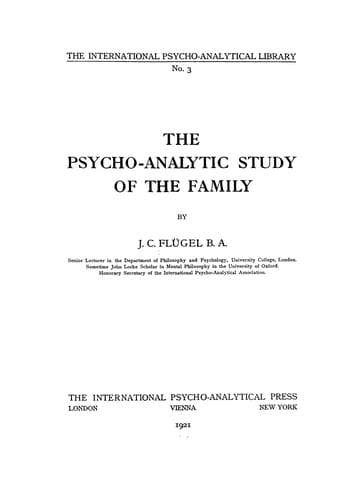
The psycho-analytic study of the familyFlugel, J. C. (John Carl)
Science
The psycho-analytic study of the family
Flugel, J. C. (John Carl)
Families; Marriage; Parent and child; Psychoanalysis
All these interpretations are probably correct, so far as they go and
as regards certain cases. Certainly the desire for the preservation
or recovery of youth, the attainment of immortality, the ensuring of
a good harvest or even the felt need of spiritual regeneration are
sufficiently strong and recurrent motives of the human mind to justify
their frequent appearance in symbolic form. Nevertheless, from what we
know of the conditions governing the most deeply rooted and widespread
human phantasies and from the general laws which underlie the use of
symbolism[63], it would seem likely that in a considerable number of
cases the meaning of the ideas of re-entering the womb and of re-birth
is not exhausted by these interpretations. The frequency and relative
uniformity of these womb and birth phantasies make it probable that, in
one of their aspects at least, they are no mere symbols but represent
things actually desired on their own account. The actual return to the
womb does, as we have seen, represent the extreme expression of the
tendency to escape from the troubles of the outer world to a condition in
which there is complete immunity from effort, responsibility, difficulty
and danger. Further, psychoanalytic investigation of the womb and birth
phantasies as they occur in individuals seems to show that they often have
a _sexual_ or quasi-sexual significance, being the expression of sexual
tendencies and arousing sexual feeling[64]. Through the extreme intimacy
which a child establishes with its mother by the processes of gestation
and birth, it may find in imagination by means of these processes a not
unsuitable method of gratifying the sexual inclinations which it feels
towards its mother; and the phantasies of entering or emerging from the
womb or of being carried in it may thus come to take on a directly sexual
character, in the same way as any other of the numerous activities or
processes associated with erotic feeling. It is probable too that in men
and boys, the process of passing to or from the womb through the vagina is
treated, on the principle of _totum pro parte_, as a substitute for the
more directly sexual act appropriate to later life--the individual having
enjoyed, on the occasion of his birth, the privilege of being in that
place, whence his incestuous desires impel him to return. In this sense
then, the womb and birth phantasies express the incestuous tendencies in a
milder and less objectionable form[65].
In girls (or in boys, in so far as they possess homosexual inclinations)
the return to the mother may be used as a means of attaining sexual
intimacy with the father, indirectly through fusion, or identification,
with the mother[66].
[Sidenote: Sexual curiosity]
Public-domain text, read in full here on John Shaqi.
Reviews
Reviews
No reviews yet
Be the first to share your thoughts on this work.
Elsewhere in the archive
Join the Discussion
Join the discussion
Sign in to leave a comment or review.
Sign InorCreate an account