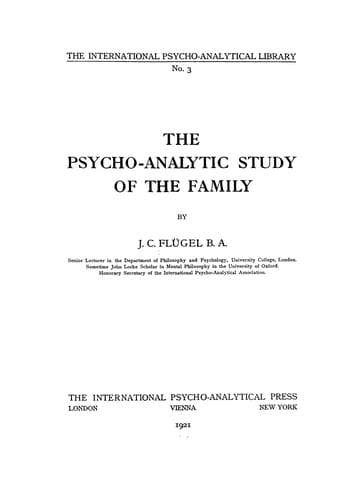
The psycho-analytic study of the familyFlugel, J. C. (John Carl)
Science
The psycho-analytic study of the family
Flugel, J. C. (John Carl)
Families; Marriage; Parent and child; Psychoanalysis
This tendency is moreover liable to be largely reinforced--or at least
complicated--by the other factors to which we referred above. The
second of these sources of difficulty (the one which is indeed most
intimately connected with our present line of thought) lies in the
fact that the child-in-law himself is frequently unable to regard his
parents-in-law with impartial eyes, but transfers to them some of the
feelings of love or of hatred which he originally directed towards his
own parents. This is perhaps most often and most openly manifest in the
case of hostile emotions; men or women expressing relatively freely
towards a father-in-law or mother-in-law respectively those feelings of
hatred which they had felt (but had perhaps repressed) with reference
to the corresponding parents by blood. The natural identification of
their parents-in-law with their own parents, in virtue of which this
displacement of affect is enabled to take place, is often facilitated
by the operation of the factor we have already considered--a parent
fixation in the case of the other partner to the marriage. Where such a
fixation exists, a father-in-law or mother-in-law may be felt to be in
some sort a sexual rival, in very much the same way as was at one time
the original parent (p. 17). Thus (to return to the example that we just
now used) a husband may feel that his father-in-law unduly influences
his wife and absorbs much of her affection and interest to the detriment
of that devoted to himself: this recalls the earlier situation in which
a similar rival--his own father--exercised a similar influence over the
then object of his affection, his own mother; and as a result of an
unconscious identification of the new situation with the old, the hostile
feeling originally directed towards his own father may be re-awakened
and transferred to the father-in-law. In this way the feeling of enmity
directed towards the latter may be more intense than that which would be
really appropriate to the situation. Any recently aroused (and perhaps to
some extent legitimate) feeling of annoyance is reinforced by the emotions
set free by the stirring up of the still powerful parent complexes of
infancy and childhood.
[Sidenote: Love]
Public-domain text, read in full here on John Shaqi.
Reviews
Reviews
No reviews yet
Be the first to share your thoughts on this work.
Elsewhere in the archive
Join the Discussion
Join the discussion
Sign in to leave a comment or review.
Sign InorCreate an account