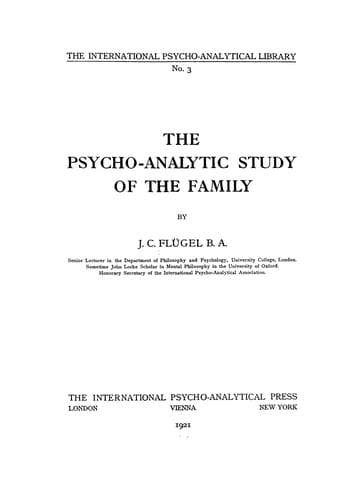
The psycho-analytic study of the familyFlugel, J. C. (John Carl)
Science
The psycho-analytic study of the family
Flugel, J. C. (John Carl)
Families; Marriage; Parent and child; Psychoanalysis
In recent times the relationship by marriage which has attracted most
attention is that of parent-in-law and child-in-law. In view of the
complex nature of the relations between parent and child and of the
elaborate process of re-adjustment in these relations which takes place
in the course of normal development, it is only to be expected that,
when a person suddenly acquires, as it were, new parents by the act
of marriage, he should experience some difficulty in establishing a
satisfactory relationship with these new parents, with whom, unlike his
own original parents, he may have had but little time or opportunity to
grow acquainted. To this general cause tending to make the relationship
between children-in-law and parents-in-law one of difficulty, there are
often added at least three further special sources of embarrassment, to
the consideration of which we may perhaps profitably devote a few words
here. In the first place, husbands and wives are not free to adjust their
relations to their parents-in-law according to the inclinations of the
two parties directly concerned, but must (if they are to be successful)
also bring these relations into some degree of harmony with those of their
partners in marriage towards these same parents (in this case parents by
blood): this is often far from easy, especially if, as so often happens,
either husband or wife or both have not entirely freed themselves from
their original infantile attitude towards their parents. Thus let us
suppose that a young woman at the time of her marriage still retains a
large amount of veneration and (unconscious) love towards her father.
This may cause her even after marriage to look to her father rather than
her husband as the source of her ideals and aspirations, to mould her
life according to his, rather than her husband's, precept and example,
and generally to adopt an attitude towards her father, which her husband
(who does not altogether share her--probably exaggerated--views as to
her father's admirable qualities) can scarcely be expected to imitate or
to approve. A very similar difficulty may be brought about in the case
of daughter-in-law and mother-in-law, where a son has retained an unduly
infantile attitude towards his mother; while in still other cases the
trouble may be due to an exaggerated dependence of husband or wife upon
the parent of his or her own sex, _i. e._, the husband upon his father,
or the wife upon her mother respectively. It is obvious that a fixation
of this kind on the side of either partner in a marriage may (quite apart
from its influence on the harmony of the marriage itself) be sufficient to
bring about a very considerable degree of difficulty in the relationship
between one partner and the parents of the other.
[Sidenote: The displacement of affect from parents to parents-in-law]
[Sidenote: Hate]
Public-domain text, read in full here on John Shaqi.
Reviews
Reviews
No reviews yet
Be the first to share your thoughts on this work.
Elsewhere in the archive
Join the Discussion
Join the discussion
Sign in to leave a comment or review.
Sign InorCreate an account