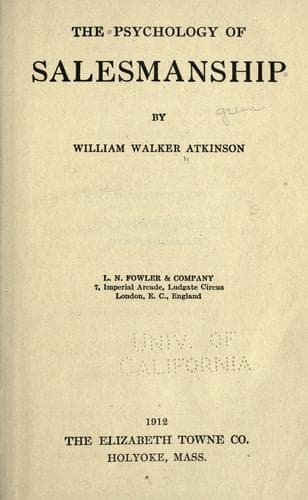
The Psychology of SalesmanshipAtkinson, William Walker
Science
The Psychology of Salesmanship
Atkinson, William Walker
Selling -- Psychological aspects
Always have the order blank, or book, and the fountain pen handy. Avoid
fiddling around after the pen or the book, or both--this is suggestive
in the wrong direction. Some salesmen lay the pen on top of the order
book, and place them easily before the prospect while talking. Others
lay the pen by the side of the book, in the same way. Collins says: "One
of the leading newspapers in the Middle West has a school for the
canvassers who solicit subscriptions. A set of books is sold in
connection with a year's subscription to this paper, and the solicitors
are drilled in old fashioned bookselling tactics, learning their
argument by rote. At the precise point where the signature of the
prospect is to be secured the salesman is taught to take his pencil from
his pocket, drop it on the floor apparently by accident, stoop over and
pick it up as he finishes his argument, and put it into the prospect's
fingers as a matter of course. Six times in ten the signature is written
without more argument." The psychological point employed here is
evidently that of distracting the prospect's mind from his ordinary
objection, and attracting his attention to the recovered pencil. A
similar proceeding is that followed by certain salesmen who carry a
large fountain pen with a rubber band wrapped around the handle. Talking
cheerfully, they drop the pen on the prospect's desk, close to his hand.
The rubber band makes it fall noiselessly, and prevents it from rolling.
The prospect is said usually to involuntarily pick up the pen, and move
it toward the order book which has been deftly placed before him, and,
then, still absorbed in the talk of the Salesman, he signs the order
blank. These methods are given for what they are worth, and in the way
of illustrating a psychological principle. Personally, we do not favor
these methods, and prefer the orthodox fountain pen, courteously handed
the prospect, at the "suggestive slant," with possibly the point
touching the line as an illustration of the "on this line, please,"
which accompanies it.
The principle to be observed in all cases where orders have to be
signed, receipts made out, etc., is to make the process as easy as
possible for the prospect. Let him work along the line of the least
resistance. Avoid giving him the adverse suggestion of "red tape,"
formality, "iron-clad contracts," etc. Act upon the principle of the
young man who when he asked his father for money would say it very
smoothly and _rapidly_ "twenty dollars please," as if it were twenty
cents. Smooth away every item of delay and friction, and adopt the
"rubber tire and ball bearings" mental attitude and mode of procedure.
Regarding the much disputed and vexing question of the interval between
Decision and Action, and the frequent failure of Decision to take form
in Action--which question, by the way, is very important in the Closing
of the Salesman--we ask you to read the following from the pen of Prof.
William James, the eminent psychologist:
Public-domain text, read in full here on John Shaqi.
Reviews
Reviews
No reviews yet
Be the first to share your thoughts on this work.
Elsewhere in the archive
Join the Discussion
Join the discussion
Sign in to leave a comment or review.
Sign InorCreate an account