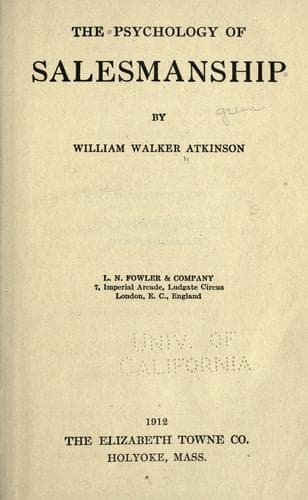
The Psychology of SalesmanshipAtkinson, William Walker
Science
The Psychology of Salesmanship
Atkinson, William Walker
Selling -- Psychological aspects
It will be seen then that the "motor cue" which releases the spring of
Action--the mental trigger which fires the gun of will--may easily be
some remote idea _suggested_ to the mind, as for instance the sight of
the slanted fountain pen and order book. The man wants to, but does not
feel like getting out of bed, and his mind becomes inactive on the
question. If some friend had said to him, "Come, get out old fellow;" or
if he had had his mind suddenly attracted by some outside sound or
sight, he would have sprung out at once. As we have said, elsewhere, the
placing of a piece of twisted paper in the ear of a horse will cause him
to forget his balkiness--it changes his current of thought. Any new
impulse will tend to get a man over his period of "I want to but I
don't" mental hesitancy. We may have given you the psychology of the
thing here--you must work it out in the details of application to suit
your own requirements. Learn to show your prospect something that will
cause him to spring out of bed. Learn to stick the piece of twisted
paper in his ear, to overcome his balkiness. Give him the "motor cue" by
supplying him with a mental image "either of the resident or remote
kind." Like the boy shivering on the brink of the stream, he needs but a
"little shove" to make him take the plunge. Then he will call to others:
"Come on in, the water's fine."
And, now in conclusion: You have the signed order, but you must continue
your Mental Attitude until you fade from the prospect's sight. Do not
gush or become maudlin, as we have seen salesmen do. Maintain your
balance, and thank your customer courteously, but not as the recipient
of alms. Keep up his good impression of and respect for you to the last.
Leave the prospect with this thought radiating from your mind: "I have
done this man a good turn." The prospect will catch these subtle
vibrations, in some way not worth discussing, and he too will feel that
he has done well. Avoid the "Well, I landed this chap, all right, all
right!" mental attitude, which shows so plainly in the manner of some
salesmen after they have booked an order. The prospect will catch those
vibrations also, and will not like it--he will resent it, naturally. In
short, you would do well to follow the homely but scientific advice of
the old salesman who said: "Keep your sugar-coating on to the
last--leave 'em with a pleasant taste in their mouths." Make a good Last
Impression as well as a good First Impression.
Public-domain text, read in full here on John Shaqi.
Reviews
Reviews
No reviews yet
Be the first to share your thoughts on this work.
Elsewhere in the archive
Join the Discussion
Join the discussion
Sign in to leave a comment or review.
Sign InorCreate an account