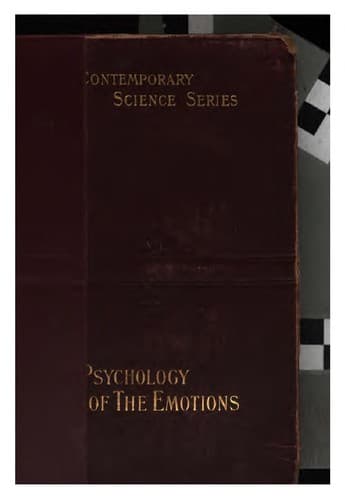
The Psychology of the EmotionsRibot, Th. (Théodule)
Science
The Psychology of the Emotions
Ribot, Th. (Théodule)
Emotions
------------------------------------------------------------------------
Transcriber’s Note:
This version of the text cannot represent certain typographical effects.
Italics are delimited with the ‘_’ character as _italic_.
Footnotes have been moved to follow the paragraphs in which they are
referenced.
Minor errors, attributable to the printer, have been corrected. Please
see the transcriber’s note at the end of this text for details regarding
the handling of any textual issues.
_THE CONTEMPORARY SCIENCE SERIES._
---------------------------------------------------------
EDITED BY HAVELOCK ELLIS.
THE PSYCHOLOGY OF THE EMOTIONS.
THE PSYCHOLOGY OF
THE EMOTIONS
BY
TH. RIBOT
PROFESSOR AT THE COLLEGE OF FRANCE, EDITOR OF THE
“REVUE PHILOSOPHIQUE.”
-------
LONDON
WALTER SCOTT, LTD., PATERNOSTER SQUARE
1897
PREFACE.
-------
The psychology of states of feelings, it is generally recognised, is
still in a confused and backward condition. Although it has benefited in
some measure by the contemporary allurement of psychological research,
it must be acknowledged that it has only exerted a moderate seduction
upon workers; the preference has been given to other studies, such as
those of perception, of memory, of images, of movement, of attention. If
any proof is necessary we may find it in the bibliographies, now
published in Germany, America, and France, which give the psychological
inventory of each year; of the whole number of books, memoirs, and
articles which appear, less than the twentieth part, on an average,
relates to the feelings and emotions. It is a very small part compared
to the part played by the emotions and passions in human life, and this
region of psychology is not deserving of such neglect. It is true that
in recent years W. James and Lange seem to have brought this state of
stagnation to an end. Their thesis, paradoxical in appearance, has
aroused, especially in America, many discussions, criticisms, defences,
and, what is of more value, observations and researches.
Public-domain text, read in full here on John Shaqi.
Reviews
Reviews
No reviews yet
Be the first to share your thoughts on this work.
Join the Discussion
Join the discussion
Sign in to leave a comment or review.
Sign InorCreate an account