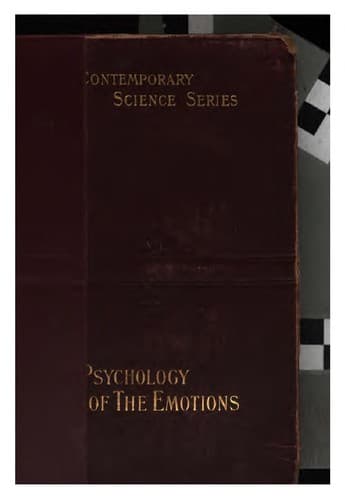
The Psychology of the EmotionsRibot, Th. (Théodule)
Science
The Psychology of the Emotions
Ribot, Th. (Théodule)
Emotions
To sum up, every event of this kind, reduced to its simplest
expression, consists in (1) an intellectual fact, analogous to a
spring moving the whole machine, (2) an unconscious, half-conscious,
or conscious reaction of the instinct of self-preservation; this
being by no means an entity, as we have already said, but the
organism itself under its dynamic aspect.
2nd Period.—_Perceptions, images, or ideas connected with social
conditions of existence._
Up to the present, we have only considered emotional reaction in its
relations with nature—_i.e._, with the physical environment. Its
domain is much more extensive; in man, and in many animals, it is
adapted to the social environment. At bottom, the mechanism remains
the same. A perception, an image, or an idea excites an emotion,
because related, directly or indirectly (in the latter case the
relation is conceived, inductively or deductively), to the social
conditions of the individual. The natural _ego_ has its needs and
tendencies; the same is true of the social _ego_, grafted on the
other, or rather, one with it; consequently, the mechanism comes
very frequently into play; the circumference is extended, but the
centre remains the same.
Let us note the differences between the two periods. In the latter
we have (1) a preponderance of representations and concepts—_i.e._,
the superior forms of knowledge; (2) instead of a natural, innate
association between certain perceptions and certain emotional
reactions—associations which may be called anatomical, because fixed
in the individual organism—there are secondary, acquired
associations, less solidly fixed, sometimes entirely artificial,
which result from experience, from education, from habit, from
imitation. I give some examples, by way of elucidation, and in order
to avoid repetition.
The feeling of property is derived from a natural condition of
existence—nutrition. It is first manifested—in the form of a
prevision—in some animals who store up a reserve of food for the
future. In primitive man this instinct extends to clothes, weapons,
the cave or hut which he inhabits; later on, with the nomadic life,
to herds and flocks; then to agricultural products, silver, gold,
paper money; finally to that impalpable thing called credit, which
has merely an imaginary existence. Thus it gradually takes on a
social character. The knowledge of any loss or any gain, actual or
possible, produces an emotion in the individual, because it shows
him that his adaptation to social conditions is diminished or
augmented.
Public-domain text, read in full here on John Shaqi.
Reviews
Reviews
No reviews yet
Be the first to share your thoughts on this work.
Elsewhere in the archive
Join the Discussion
Join the discussion
Sign in to leave a comment or review.
Sign InorCreate an account