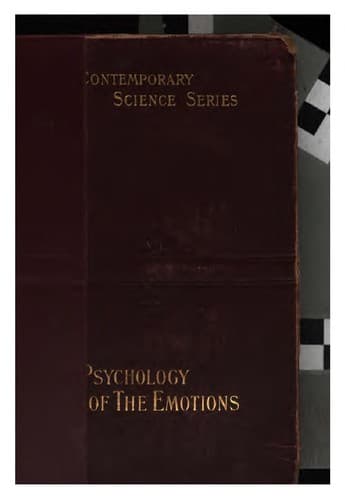
The Psychology of the EmotionsRibot, Th. (Théodule)
Science
The Psychology of the Emotions
Ribot, Th. (Théodule)
Emotions
The sentiment of “self-feeling” is innate, primary. Let us imagine
ourselves in a society where the questions of rank, precedence,
etiquette, are of capital importance—in an aristocratic monarchy
like that of Louis XIV.—and we shall see what a ferment of emotions
may be raised by an occurrence which, to our eyes, seems futile and
irrelevant. If we read Saint-Simon’s _Mémoires_, we see him boiling
over with indignation when a courtier is unduly accorded the
privileges of a duke and peer, and his wife is granted a stool in
the Queen’s presence. He spends his time in incessant visits, forms
coalitions, does all in his power to move the ministers or the
Parliament, and finally exults in his victory. However factitious
and puerile this agitation may seem, it results from the same
physiological mechanism as the simplest emotions: from the instinct
of personal preservation—not of his natural _ego_, but of his _ego
qua_ courtier of the Grand Monarque. If he fails, he is injured,
depreciated, lessened in his conditions of social existence.
The case already cited, of Malebranche, to whom Descartes’ _Traité
de l’homme_ “caused such violent palpitations of the heart that he
was obliged continually to leave his book in order to breathe,”
called forth Fontenelle’s remark that “Truth, which is invisible and
of no practical utility, is not wont to find so much sensibility
among men.” No doubt; but to the true man of science the pursuit of
truth is one of the necessary conditions of existence. For others it
is a mere luxury, to the loss of which they are quite indifferent.
I think we have thus replied to the question previously put—why
certain sensations, images, ideas, have the privilege of producing
organic and motor changes which, translated into the language of
consciousness, constitute the emotional state—and justified our
answer. The sensation, the image, the idea, are only occasional
causes, incapable by themselves of producing any emotion: it
springs from the inmost personality of the individual—from his
_organisation_—expresses it directly, and participates in its
stability and its instability.
IV.
Public-domain text, read in full here on John Shaqi.
Reviews
Reviews
No reviews yet
Be the first to share your thoughts on this work.
Elsewhere in the archive
Join the Discussion
Join the discussion
Sign in to leave a comment or review.
Sign InorCreate an account