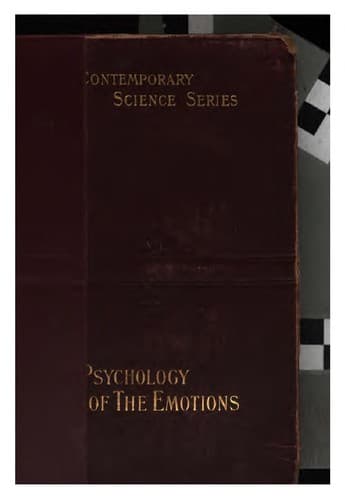
The Psychology of the EmotionsRibot, Th. (Théodule)
Science
The Psychology of the Emotions
Ribot, Th. (Théodule)
Emotions
The hypothesis of James and Lange—considered, at first, as a
paradox—has suggested so many remarks, criticisms, objections,
answers, and arguments for and against, that I find it impossible to
give a summary of them.[77] Yet it is not without precedent. Lange,
in his _Addenda_, mentions as his precursors, Malebranche, Spinoza,
and some other less celebrated authors. The legitimate claims of
Descartes, in his treatise _Sur les Passions de l’Âme_, have also
since been vindicated.[78] The physiologists, too, ought not to be
forgotten: Maudsley indicated the same view, without insisting on
it.[79] The superiority of James and Lange consists in having put it
clearly and endeavoured to support it by experimental proofs. I have
already said that it seems to me the most probable explanation for
those who do not represent the emotions to themselves as
psychological entities. The only point in which I differ from these
authors relates to their way of putting the proposition, not to its
substance.
-----
Footnote 77:
I may indicate, somewhat at random, the principal documents for
this controversy: Wundt, _Philosophische Studien_, vi. 3, p. 349
(he criticises Lange only); Gurney, _Mind_, July 1884; Marshall,
_ib._, October 1884; Stanley, _ib._, January 1886; Worcester,
_Monist_, January 1893; _Psychological Review_, September and
November 1894, January 1895, etc.
Footnote 78:
“Though written in the earliest days of modern science, this work
will bear comparison with anything that has been produced in
recent years. It will be difficult, indeed, to find any treatment
of the emotions much superior to it in originality, thoroughness,
and suggestiveness. The position maintained is similar to that now
held by Professor James, but Descartes does not content himself
with defending in a general way the assertion that emotion is
caused by physical change. After coming to the conclusion that
there are six passions from which all the others are derived, he
attempts to show that a special set of organic effects is
concerned in the production of each of these primary states.”—D.
Irons in _Philosophical Review_, May 1895, p. 291.
Footnote 79:
“When any great passion causes all the physical and moral
troubles which it will cause, what I conceive to happen is that
a physical impression made on the sense of sight or of hearing
is propagated along a physical path to the brain, and arouses a
physical commotion in its molecules; that from this centre of
commotion the liberated energy is propagated by physical paths
to other parts of the brain; and that it is finally discharged
outwardly through proper physical paths, either in movements or
in modifications of secretion and nutrition. The passion that is
felt is the subjective side of the cerebral commotion—its
_motion_ out from the physical basis, as it were (_e-motion_),
into consciousness.”—_Pathology of Mind_, 1879, p. 222.
-----
Public-domain text, read in full here on John Shaqi.
Reviews
Reviews
No reviews yet
Be the first to share your thoughts on this work.
Elsewhere in the archive
Join the Discussion
Join the discussion
Sign in to leave a comment or review.
Sign InorCreate an account