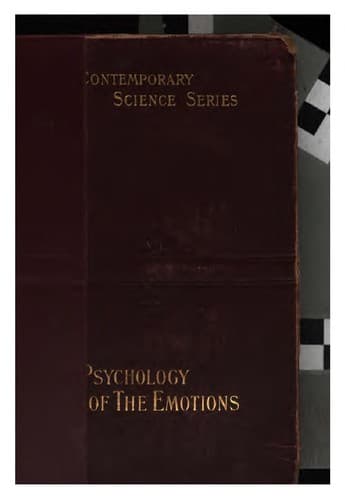
The Psychology of the EmotionsRibot, Th. (Théodule)
Science
The Psychology of the Emotions
Ribot, Th. (Théodule)
Emotions
Its origin: the craving for knowledge—Its
evolution—Utilitarian period: surprise, astonishment,
interrogation—Disinterested period: transition
forms—Classification according to intellectual
states—Classification according to emotional states:
dynamic forms, static forms—Period of passion: its
rarity—Pathology—Simple doubt—Dramatic doubt—_Folie du
doute_—Mysticism in science: deviation comes, not from the
object, but from the method of research.
CHAPTER XII.
NORMAL CHARACTERS 380
Necessity of the synthetic point of view in
psychology—Historical summary of theories of character:
physiological direction, psychological direction—Two marks
of the real character: unity, stability—Elimination of
acquired characters—Classificatory procedure: four
degrees—Genera: the sensitive, the active, the
apathetic—Species—Secondary function of the intellect: its
mode of action—Sensitives: the humble, the contemplative,
the analytical, the purely emotional—Active type: the
medium, the superior—Apathetic type: pure type,
intelligent type, calculators—Varieties: the
sensitive-active, the apathetic-active, the
apathetic-sensitive, the temperate—Substitutes for
character: partial characters; (_a_) intellectual form,
(_b_) emotional form.
CHAPTER XIII.
ABNORMAL AND MORBID CHARACTERS 405
Are all normal characters mutually equivalent?—Attempt at
classification according to their value-Marks of abnormal
character: absence of unity, impossibility of
prevision—Class I. Successive contradictory characters:
anomalies, conversions; their psychological mechanism.
Alternating characters—Second class: Contradictory
coexistent characters. Incomplete form: contradiction
between principles and tendencies. Complete form.
Contradiction between one tendency and another—Third
class: Unstable characters. Their physiological and
psychological characters—Psychological infantilism.
CHAPTER XIV.
THE DECAY OF THE AFFECTIVE LIFE 423
Law of Decay: its formula, and its general application in
psychology—Difficulties where the affective life is
concerned—Successive disappearance of the disinterested
emotions (the æsthetic and intellectual), of the
altruistic (moral and social), the ego-altruistic
(religious feeling, ambition, etc.), and lastly, the
egoistic—Converse proof: cases of arrested
development—Theory of degeneration—Its relation to decay.
CONCLUSION 438
The place of the feelings in psychic life—They come
first—Physiological proofs—Psychological proofs.
Public-domain text, read in full here on John Shaqi.
Reviews
Reviews
No reviews yet
Be the first to share your thoughts on this work.
Join the Discussion
Join the discussion
Sign in to leave a comment or review.
Sign InorCreate an account