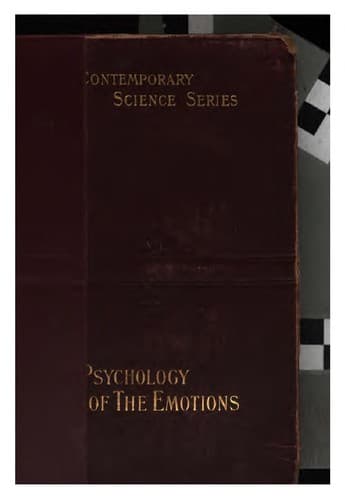
The Psychology of the EmotionsRibot, Th. (Théodule)
Science
The Psychology of the Emotions
Ribot, Th. (Théodule)
Emotions
I maintain, on the contrary, that we have here only two different
stages of the same thing; the first ineffectual and abortive, the
second complete; and the subject which now occupies us must either
have been in a very confused state, or very negligently treated, for
a clear mind like that of W. James not to have seen that affective
memories, like others, aim at becoming actual states of feeling. We
ought not, however, to forget the indisputable fact that our
consciousness only exists in the present. For a recollection,
however distant, to exist, as far as I am concerned, it must
re-enter the narrow area of _present_ consciousness; otherwise it is
buried in the depths of the unconscious and equivalent to the
non-existent. We have thus (not to speak of the present-future) a
present-present and a present-past—viz., that of memory; and this is
only distinguished from the other by certain additional marks which
it is needless to enumerate, but which consist principally in its
appearing like an initial state, though, in general, less intense.
Now these indispensable conditions of memory are the same for both
intellectual and emotional states. If, with my eyes shut, I can call
up the vision of St. Peter’s at Rome (if I were an architect, with a
good visual memory, I should see it in all its details), my
impression is an _actual_ one, and only becomes a memory by the
addition of secondary characteristics, such as repetition and a
lower degree of intensity. The two cases are similar; in both, the
revived impression, according to the law formulated by Dugald
Stewart and Taine, is accompanied by a momentary belief which places
it in the position of an actual reality. But the recollection of a
feeling, it will be said, has this special property, that it is
associated with organic and physiological states which make of it a
real emotion. I reply that it _must_ be so, for an emotion which
does not vibrate through the whole body is nothing but a purely
intellectual state. To expect that we should actually revive a state
of feeling without reviving also its organic conditions, is to
expect the impossible, to state the problem in contradictory terms.
We should, in that case, simply have its substitute, its
abstraction, _i.e._, the false affective memory which is a variety
of intellectual memory; the emotion will be _re_cognised, not
_re_vived.
Finally, the ideal of every recollection is that, while keeping its
character of being already experienced, it should be adequate in
such measure as was possible for the original impression. The
revival of impressions is an internal operation, whose extreme form
is hallucination. For the two forms of memory, intellectual and
emotional, the ideal is the same, only each has its special
mechanism for realising it.
Public-domain text, read in full here on John Shaqi.
Reviews
Reviews
No reviews yet
Be the first to share your thoughts on this work.
Elsewhere in the archive
Join the Discussion
Join the discussion
Sign in to leave a comment or review.
Sign InorCreate an account