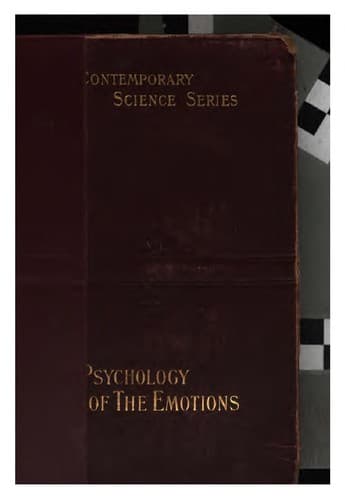
The Psychology of the EmotionsRibot, Th. (Théodule)
Science
The Psychology of the Emotions
Ribot, Th. (Théodule)
Emotions
The study just made seems to me to lead to the following
conclusions:—
1. There exists an AFFECTIVE TYPE as clear and well-defined as the
visual, the auditory, and the motor types. It consists in the easy,
complete, and preponderant revival of affective impressions.
I have simply applied to an almost unexplored region of memory the
methods of research inaugurated for objective sensations by Taine
and Galton, continued by many others, and successful in their hands.
It will, perhaps, be objected that the complete emotional type is
rarely found; but neither is it certain that the visual, auditory,
and motor types are of very frequent occurrence in a pure state.
This, however, is of little consequence, the essential point being
to determine its existence. Those who belong to this type will
easily recognise it. I foresee that those whose memories are of the
opposite type will refuse to admit it; but the members of the Royal
Society and the Académie des Sciences,—being for the most part
possessed of non-visual memories,—when questioned by Galton, failed
to understand his queries, and would probably have rejected his
conclusions. Many men have an incurable tendency to wish that every
one were constituted like themselves, and to refuse to admit the
existence of any departures from their type. Yet in psychology, even
more than elsewhere, we must be distrustful of too extensive
generalisations.
2. There exists not only a general emotional type; it admits of
varieties, and it is even probable that _partial_ types are the most
frequent. Here I note a resemblance between my researches and those
made with regard to impressions of objective origin. It is known
that some persons have an excellent memory for faces, figures,
concrete objects, but not for colours or visual signs, such as
printing and writing. Others have an excellent memory for languages
but none for music, or inversely. Moreover, have not numerous
pathological phenomena demonstrated the fact that, in a determinate
category of images, a whole group may disappear, without appreciable
injury to the rest?
I have not at present a sufficient supply of documents to enter on
the study of the varieties of the affective type; but it is certain
that they exist; that, for some, a clear and frequent revival only
takes place in the case of pleasurable impressions; in others, of
gloomy or of erotic images. I have obtained conclusive affirmative
answers on this point, but will only transcribe a case which deals
with fear.
Public-domain text, read in full here on John Shaqi.
Reviews
Reviews
No reviews yet
Be the first to share your thoughts on this work.
Elsewhere in the archive
Join the Discussion
Join the discussion
Sign in to leave a comment or review.
Sign InorCreate an account