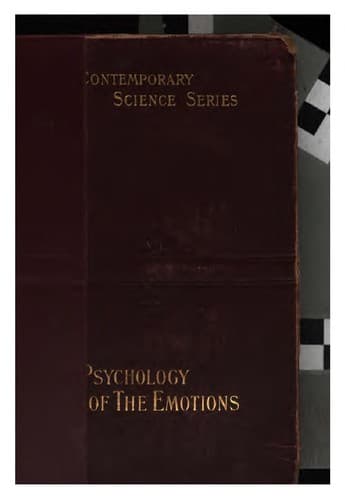
The Psychology of the EmotionsRibot, Th. (Théodule)
Science
The Psychology of the Emotions
Ribot, Th. (Théodule)
Emotions
For the others (whose opinion I adopt), the whole may be explained
on physico-chemical grounds. No doubt there is affinity, attraction
and repulsion, but only in the scientific sense; these words are
metaphors derived from the language of consciousness which should be
purged of all anthropomorphic elements. Several authors have shown
by numerous observations and experiments the chemical conditions
which determine or prevent this pretended choice (Sachs, Verworn,
Löb, Maupas, Bastian, etc.).
On this point, as on all questions of origin, we must decide
according to probabilities, and the probabilities appear to be all
in favour of the chemical hypothesis. In any case, this matter has
only a secondary interest for us here. If we admit conscious
tendencies, then the origin of the emotional life coincides with the
very origin of physiological life. If we eliminate all psychology,
there still remains the physiological tendency, that is to say the
motor element, which in some degree, from the lowest to the highest,
is never quite wanting.
This excursion into the pre-conscious period—since we so regard
it—puts us in possession of one result. At the end of this
investigation we find two well-defined tendencies, physico-chemical
and organic—the one of attraction, the other of repulsion; these are
the two poles of the life of feeling. What is attraction in this
sense? Simply assimilation; it blends with nutrition. With sexual
attraction, however, we must note that we already reach a higher
grade; the phenomenon is more complex, the monocellular being no
longer acts to preserve itself but to maintain the species. As to
repulsion, we may remark that it is manifested in two ways. On one
side it is the opposite of assimilation: the cell or the tissue
rejects what does not suit it. On another side, at a somewhat
superior stage, it is in some degree already defensive.
We have thus gained a basis for our subject by finding that beneath
the conscious life of feeling there exists a very low and obscure
region, that of vital or organic sensibility, which is an embryonic
form of conscious sensibility and supports it.
II.
Public-domain text, read in full here on John Shaqi.
Reviews
Reviews
No reviews yet
Be the first to share your thoughts on this work.
Join the Discussion
Join the discussion
Sign in to leave a comment or review.
Sign InorCreate an account