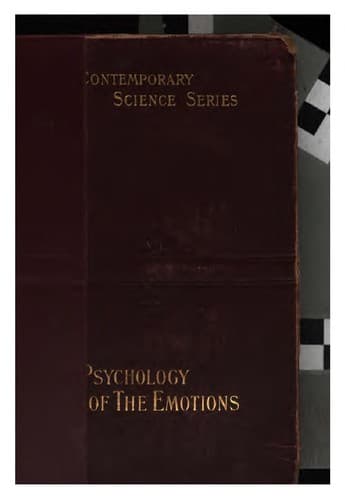
The Psychology of the EmotionsRibot, Th. (Théodule)
Science
The Psychology of the Emotions
Ribot, Th. (Théodule)
Emotions
We can find numerous and simple examples in common life. The lover
transfers the sentiment at first called forth by the person of his
mistress to her clothes, her furniture, her house. For the same
reason, hatred and jealousy vent their rage on inanimate objects
belonging to the enemy. In absolute monarchies the reverence in
which the king’s person is held is transferred to the throne, to the
emblems of his power, to everything directly or indirectly connected
with his person. The following charming passage from Herbert Spencer
relates to a less simple case of the same nature: “The cawing of
rooks is not in itself an agreeable sound; musically considered, it
is very much the contrary. Yet the cawing of rooks usually produces
pleasurable feelings—feelings which many suppose to result from the
quality of the sound itself. Only the few who are given to
self-analysis are aware that the cawing of rooks is agreeable to
them because it has been connected with countless of their greatest
gratifications—with the gathering of wild flowers in childhood; with
Saturday afternoon excursions in schoolboy days; with midsummer
holidays in the country, when books were thrown aside and lessons
were replaced by games and adventures in the field; with fresh,
sunny mornings, in after years, when a walking excursion was an
immense relief from toil. As it is, this sound, though not causally
related to all these multitudinous and varied past delights, but
only often associated with them, rouses a dim consciousness of these
delights; just as the voice of an old friend, unexpectedly coming
into the house, suddenly raises a wave of that feeling which has
resulted from the pleasures of past companionship.” We must remark
that in the transfer by contiguity, which, by its very nature is
automatic, the intellectual states act as _causes_, since the
extension of the sentiment is subordinated to them.
_Transference by Resemblance._—When an intellectual state has been
accompanied by a vivid sentiment, every similar or analogous state
tends to excite the same feeling.
Public-domain text, read in full here on John Shaqi.
Reviews
Reviews
No reviews yet
Be the first to share your thoughts on this work.
Elsewhere in the archive
Join the Discussion
Join the discussion
Sign in to leave a comment or review.
Sign InorCreate an account