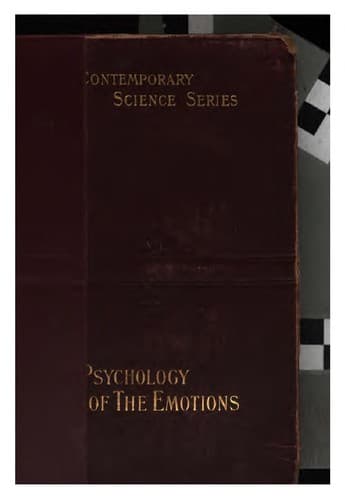
The Psychology of the EmotionsRibot, Th. (Théodule)
Science
The Psychology of the Emotions
Ribot, Th. (Théodule)
Emotions
In this psychological fact lies the secret of the emotion of love,
tenderness, antipathy, respect, which we feel towards a person at
first sight, without apparent reason, and which we are apt to put
down to the account of instinct. But those who devote themselves to
the analysis of their own consciousness will discover, in many
cases, a more or less close resemblance to a person who inspires, or
has inspired, us with love, tenderness, antipathy, or respect. A
mother may feel a sudden sympathy for a young man who is like her
dead son, or even merely of the same age. The explanation of many of
these cases lies in an unconscious state which is not easy to seize,
but which, if it returns to consciousness (a process in which the
will is only very indistinctly concerned), elucidates everything.
There are also so-called instinctive fears, without conscious
motives, which, by going a little below the surface, can be referred
to the same explanation.[117]
-----
Footnote 117:
This point has been well treated by Lehmann, _op. cit._, p. 244.
-----
This transfer can take place in two ways, one narrow, the other
broad. The narrow method rests on resemblance only: B resembles A,
the perception or representation of whom is or was accompanied by a
certain feeling; the transfer goes no further. The broader method
rests on analogy, and has a much wider scope; it passes from one
individual to several—to a class or classes. “A friend of mine,”
says Lehmann, “hated dogs; circumstances forced him to keep one; he
attached himself to this animal, and gradually his feeling of
sympathy spread to the whole canine race” (_loc. cit._). This
possibility of a limited transfer has been a social and moral factor
of the first importance; it has allowed of the extension of the
sympathetic sentiments from the small exclusive clan to more and
more distant groups—the tribe, the nation, the human race. The wider
transfer has been the great agent of the transition from
particularism to universalism.[118]
-----
Footnote 118:
The mechanism of the suppression of the presentative intermediary
between the initial state A and the distant states O, II, I, etc.,
has been studied by J. Sully (ii. 79). I do not insist on this
point, which belongs rather to the psychology of association than
to that of the emotions.
-----
II.
From the unconscious states to the affective states, of which the
subject is fully conscious, the transition is made gradually and
through doubtful forms; but whether obscure, semi-obscure, or clear,
their influence remains the same. Among the numerous cases in which
the association of ideas depends on a conscious affective
disposition we may distinguish three groups:—
Public-domain text, read in full here on John Shaqi.
Reviews
Reviews
No reviews yet
Be the first to share your thoughts on this work.
Elsewhere in the archive
Join the Discussion
Join the discussion
Sign in to leave a comment or review.
Sign InorCreate an account