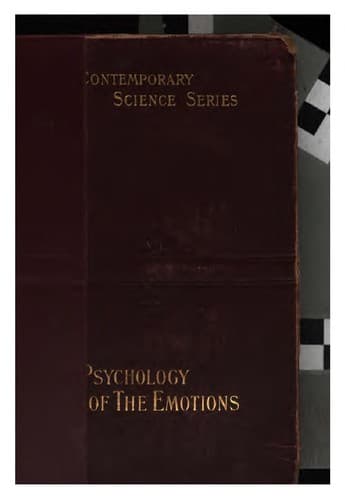
The Psychology of the EmotionsRibot, Th. (Théodule)
Science
The Psychology of the Emotions
Ribot, Th. (Théodule)
Emotions
2. Permanent and stable cases; to be met with everywhere, because
involved in the structure of the human mind. They are fixed in
language. When dealing with the expression of the emotions (Chap.
IX.) we met with “the principle of association of analogous
sensations,” formulated by Wundt. Adapting it to our present
subject, we may say that sensations imbued with a similar emotional
colouring are easily associated, and strengthen each other. Nothing
can differ more in nature than our external sensations (except smell
and taste), and the qualities which they make known to us; the data
of sight and hearing have no resemblance to one another as
cognitions of the external world, yet we speak of sombre voices,
clear voices, screaming colours, coloured music. We associate sight
with thermal sensations, as when we speak of warm or cold colours.
Taste also has its share—bitter reproaches, subacid criticism.
Finally, touch, as Sully-Prudhomme has remarked, is perhaps the most
abundant source of associations between the idea of the physical
sensation and an emotional state; compare the terms touching, hard,
tender, heavy, firm, solid, harsh, penetrating, poignant, piquant,
etc. At the bottom of all these associations there is a common
emotional colouring which both causes and supports them. Perhaps it
would be more accurate to class them among the cases of
semi-conscious emotional influence; but we have already said that
our division into conscious and unconscious factors is superficial
and of no great importance.
Public-domain text, read in full here on John Shaqi.
Reviews
Reviews
No reviews yet
Be the first to share your thoughts on this work.
Elsewhere in the archive
Join the Discussion
Join the discussion
Sign in to leave a comment or review.
Sign InorCreate an account