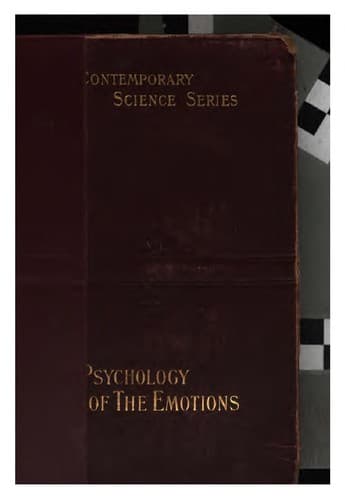
The Psychology of the EmotionsRibot, Th. (Théodule)
Science
The Psychology of the Emotions
Ribot, Th. (Théodule)
Emotions
1. Individual, accidental, ephemeral cases. These can be reduced to
a single formula: when two or more states of consciousness have been
accompanied by the same emotional state, they tend to be associated
with one another. Emotional resemblance unites and intertwines
disparate impressions. It is a case of association by resemblance,
_but not intellectual_; impressions are associated because they
resemble one another in a common emotional colouring, not _qua_
impressions. Examples of this are abundant. L. Ferri (in his
_Psychologie de l’Association_, where, by-the-bye, he does not note
this emotional law) tells us that one day, being stung by a fly, he
suddenly remembered a child seen by him, long ago, when himself very
young, on its death-bed. Whence this sudden vision? “In the first
place, I was lying on my bed, then I had been stung by a fly, and
lastly, the sight of the corpse had caused in me a deep sadness,
while, at this same moment, I also happened to be very sad.”
Association through emotional identity or resemblance is of frequent
occurrence in dreams, as has been already said. I remember, among
many others, a dream whose unity, in spite of the apparent
incoherence of the association, was due to a general sense of
fatigue. A road without milestones stretched before me, of which I
was about to complete the last stage; steep mountains kept rising
one behind another; my eyes were wearied with trying to catch sight
of the longed-for town on the horizon; and every time I wished to
inquire the way I had to speak a foreign language which I understand
but imperfectly, and in which it is very difficult for me to express
myself. I awoke, feeling a general aching and heaviness of all the
limbs. Sully relates a dream whose unity consisted in a sense of
anxiety and vexation. He was suddenly called upon to give a lecture
on Herder; he began by stammering out some generalities; then he was
addressed by one of his audience, who suggested difficulties to him;
then the entire assembly broke up tumultuously. One of his children,
who had seen, for the first time, the great clock at Strasburg, and,
after an interval of two days, the Swiss glaciers, dreamed on the
following night that the figures of the clock were walking about on
the snow. In this case the groundwork of the dream is a feeling of
admiration or surprise.
Public-domain text, read in full here on John Shaqi.
Reviews
Reviews
No reviews yet
Be the first to share your thoughts on this work.
Elsewhere in the archive
Join the Discussion
Join the discussion
Sign in to leave a comment or review.
Sign InorCreate an account