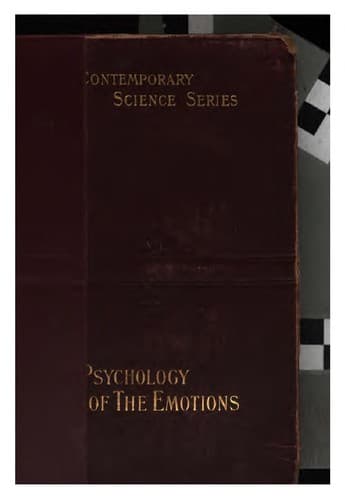
The Psychology of the EmotionsRibot, Th. (Théodule)
Science
The Psychology of the Emotions
Ribot, Th. (Théodule)
Emotions
As the visual images are the most important of all,
the shedding of tears would be an unconscious effort to drive away
sad representations, having for its foundation an analogy between
the painful sensations and the images. Whatever one may think of
these hypotheses, they consider tears as signs of pain exclusively.
The augmentation of the lachrymal secretion depends on the increase
in the pressure of the blood; now, the circulation is accelerated by
joy and tenderness, as is proved by the shining of the eyes. The
appearance of tears—not very abundant, however, in such cases—would
be the natural consequence. Sorrow, on the contrary, is accompanied
by a lowering of the circulation, and very often, in the early
stage, tears are entirely wanting. The shedding of tears produces
relief, it is a safety-valve; it would answer to a second stage—that
of slackened tension—in which the return of vitality has begun. In
other words, the tears of joy and tenderness would correspond to the
stage of action, the tears of sadness to the stage of reaction.
The psychology of tender emotion seems to me reducible to a single
question—that of its origin. The description of its varieties is
without interest, and may be found elsewhere. We have stated it as
simple and primary. Being the source of all altruistic, social, and
moral manifestations, it will be worth our while to consider its
nature at the period of its appearance.
In children, and the higher animals, the first manifestation of
tenderness is towards the mother or the nurse.
"The relation involved in the sustenance of the child, a relation
only a degree less close than that of the fœtus to the maternal
organism, constitutes in itself the chief source of the feeling.
Along with the supply of nutriment there goes that of warmth,
support, or propping, which again is a continuation of the fœtal
dependence. This first instinctive or sensuous attachment of the
child grows into what we call fondness by the complication of this
instinctive feeling with numerous “ideal” or transferred feelings,
the product of the many pleasurable sensations, including those of
the eye and of the ear, of which the mother is the source."[147] The
primary tendency, therefore, is directed, in children and animals,
to those who have been pleasant to them, or who have done them good,
and from whom they hope to receive it again. This is an emotion
which, in Herbert Spencer’s nomenclature, might legitimately be
called ego-altruistic, or even one with a marked preponderance of
egoism. It must be so, for altruism cannot be innate.
-----
Footnote 147:
Sully, _The Human Mind_, ii. pp. 104, 105.
-----
Public-domain text, read in full here on John Shaqi.
Reviews
Reviews
No reviews yet
Be the first to share your thoughts on this work.
Elsewhere in the archive
Join the Discussion
Join the discussion
Sign in to leave a comment or review.
Sign InorCreate an account