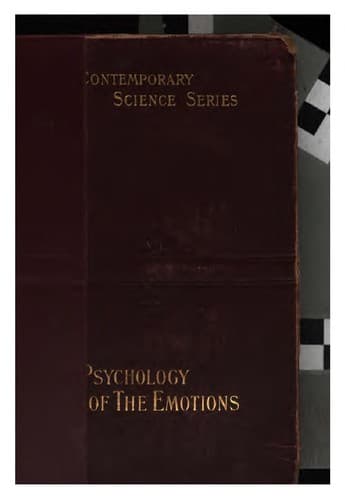
The Psychology of the EmotionsRibot, Th. (Théodule)
Science
The Psychology of the Emotions
Ribot, Th. (Théodule)
Emotions
The faculty of knowledge begins with an undifferentiated period, in
which there is neither subject nor object, but only the
consciousness of something without qualification. The separation of
the ego and the non-ego in the order of cognition is the stage
corresponding to the division, in the emotional order, between
conscious egoism and altruism. How does this partial alienation from
ourselves come about? How can it arise and be consolidated? These
questions will be discussed later, when treating of moral emotion
(Chap. VIII.). For the moment, I confine myself to a single
question: Are we confronted with a veritable instinct—with an innate
tendency incapable of being analysed, showing itself in the
consciousness by the tender emotion or its varieties?
We know all the efforts made (especially in the eighteenth century)
to reduce altruism by analysis to an extremely refined egoism, to a
calculation; thus the tenderness of parents for their children was
explained by the expectation of services to be rendered by them in
the future. I think it needless to insist on this point.
In favour of inneity, the best argument that can be alleged, because
founded on fact, is, that affection and attachment are met with even
among animals, to whom we cannot attribute calculation or interested
foresight. Apart from maternal love, which manifests itself
energetically in very low stages of the animal kingdom, we find
examples of benevolent and active sympathy between animals of the
same species, and even (though this is rarer) of different
species,[148] apart from any sexual attraction. Let us add, if
necessary, in the case of human beings: “the instantaneous,
unreflecting impulses of pity to creatures in distress, although
strangers, enemies, criminals, noxious beasts, the absence of all
balancings of immediate loss with ultimate gain.... Long-sighted
selfishness does not explain the conduct of the Good Samaritan.
Again, the hosts of human beings that in all ages have voluntarily
given up their lives for their country, could not be influenced by
their own advantage. For, although many of these have been taught
the hopes of a future existence, this has been by no means
universal; and there could be little certainty in the mass of minds
that the surrender of this life would receive a full compensation in
another.”[149]
-----
Footnote 148:
For these facts see Romanes, _Mental Evolution_, chap, xx., and
Lloyd Morgan, _Animal Life_, pp. 397, 398.
Footnote 149:
Bain, _Emotions_, chap. vi. p. 111.
-----
Public-domain text, read in full here on John Shaqi.
Reviews
Reviews
No reviews yet
Be the first to share your thoughts on this work.
Elsewhere in the archive
Join the Discussion
Join the discussion
Sign in to leave a comment or review.
Sign InorCreate an account