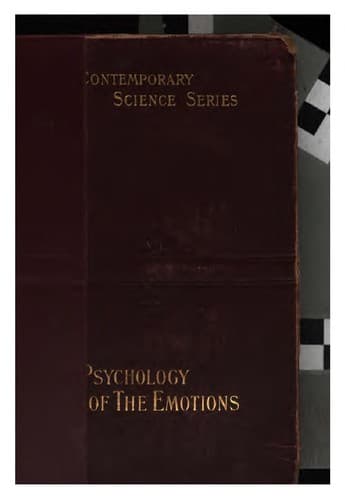
The Psychology of the EmotionsRibot, Th. (Théodule)
Science
The Psychology of the Emotions
Ribot, Th. (Théodule)
Emotions
There is nothing more characteristic than such a description as the
following, which has often been drawn up, and is yet another proof
that emotion, its expressive and its physiological bases, are but
parts of the same phenomenon. “He walks with head erect, with
assurance; his speech is laconic and imperious, he seeks solitude,
and is full of contempt for the society which surrounds him. His
style of dress is in accordance with the tendency of his aberration.
Like the maniac, he is restlessly active; but, in him, no movement
is fortuitous or without a motive; his will is always active, his
actions have a definite aim; if he shows violence, it is in order to
ensure the execution of his commands, to show that he has strength
sufficient to annihilate everything; it is not a destructive spirit
which animates him, but the necessity for showing his power. The
functions of the assimilative life have undergone no alteration;
they take place, as a rule, with perfect regularity. It seems as if
the expansive form of their feelings, their contentment with
themselves, the extreme and unbroken satisfaction surrounding their
life, imparted to the organic vital apparatus a surplus of activity,
resulting, in a manner, in an excess of health.” Frequent cases of
longevity among megalomaniacs have been noted. Finally, the
following observation has its value, on account of the change—at
once organic and psychic—there recorded:—"We have watched a patient
who, after having suffered from melancholia for several years,
suddenly became megalomaniac. His constitution had undergone great
alterations, and his health was much weakened, so that he became a
chronic melancholic; but so soon as his mental affection took on the
character of megalomania he was not long in acquiring new
vigour."[154]
Footnote 154:
Dagonet, _Traité des maladies mentales_, pp. 360 _et seq._
We might add that the tendency of men is rather to pride, of women
to vanity, which favours the views of those who maintain that
madness is often only the exaggeration of the habitual character: it
is sufficient to have shown that the feeling (though illusory) of
personal strength in an extreme degree is only the normal state
amplified, but not changed.
III.
It may seem strange to close this chapter by some remarks on a
phenomenon which, both by its internal and external characteristics,
belongs to the class of irresistible tendencies—the fatal impulse to
suicide. Its affinity with homicidal obsession is undeniable, as is
proved by the persons who are tormented, in turn, by the craving to
kill others and to kill themselves. However, if self-love, in its
positive form, reaches its culminating point in megalomania, it
seems to me quite legitimate to maintain that self-feeling, under
its negative form, attains its supreme negation in suicide.
Public-domain text, read in full here on John Shaqi.
Reviews
Reviews
No reviews yet
Be the first to share your thoughts on this work.
Elsewhere in the archive
Join the Discussion
Join the discussion
Sign in to leave a comment or review.
Sign InorCreate an account