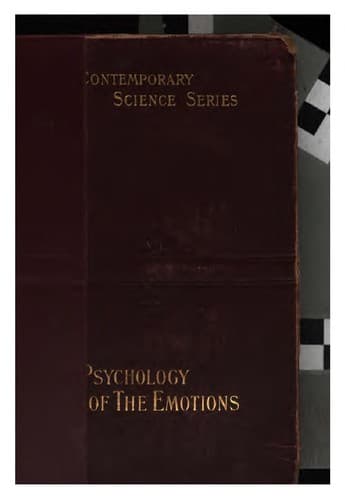
The Psychology of the EmotionsRibot, Th. (Théodule)
Science
The Psychology of the Emotions
Ribot, Th. (Théodule)
Emotions
Without insisting on a merely accessory point, it is certain that
suicide, as a manifestation of emotional life, brings us face to
face with a psychological problem as yet insufficiently noticed. If
there is an incontestable fact—one which, even among the ancients,
was familiar to triteness—it is that in every animal the
fundamental, ineradicable instinct is that of self-preservation, of
existing, and persisting in existence. Now, suicide, whether
voluntary or unreflecting, deliberate or impulsive, is the negation
of the fundamental tendency, not a theoretic or partial negation, or
one in word only, but in deed and absolute. And the sacrifice of
life is not subordinated to some other end which acts by superior
attraction, such as devotion to a belief, to friends, to humanity,
to one’s country, it is a suppression pure and simple, a liberation
desired in and for itself.
The ethnological, moral, and social study of suicide does not form
part of our subject, having already been fully worked out.[155] Our
aim is merely the psychological problem, which we must now define
with more precision.
Footnote 155:
Among the very copious existing literature on suicide I must
mention Morselli’s monograph, _Il Suicidio_, in which the various
causes—cosmic, ethnic, social, biological, and psychological—are
studied in great detail. His principal theoretical conclusions
are—(1) Among all civilised nations suicide increases more rapidly
than the geometrical ratio of the population and the general
mortality; (2) suicides are in inverse proportion to homicides at
any given time or in any given country. This last “law” has been
strongly contested by Tarde and others.
The act of suicide results from two very different mental states,
that of reflection and that of impulsion.
In deliberate, reflective, voluntary suicide there is a struggle
between two factors: the instinct of conservation and the
insupportable state caused by pain (incurable disease, ruin, misery,
grief, frustrated ambition, dishonour). Reflection decides, and as
pain is always a beginning of destruction, it prefers a total and
rapid destruction to a partial and slow one. The act is rational,
since it tends towards the lesser evil, or at least what is judged
to be such.
Impulsive suicide is harder to explain. A man throws himself
suddenly out of a window, poisons himself, cuts his throat. In some
cases death has been premeditated, but always appears as a
compelling, inevitable force, inexorably claiming its victim; the
epithet “irresistible” says everything. To the outside spectator the
act appears motiveless, without reason, without cause. It is all the
more surprising that the struggle, in this case, is no longer
between instinct and reflection, but between two instincts, the
conservative and the destructive, of which the one which usually is
the strongest succumbs, and the individual turns against himself the
destructive tendency originally destined to act on others.
Public-domain text, read in full here on John Shaqi.
Reviews
Reviews
No reviews yet
Be the first to share your thoughts on this work.
Elsewhere in the archive
Join the Discussion
Join the discussion
Sign in to leave a comment or review.
Sign InorCreate an account